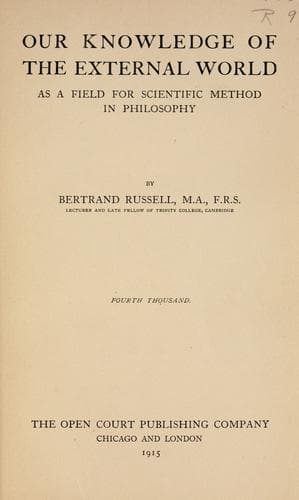
Our Knowledge of the External World as a Field for Scientific Method in PhilosophyRussell, Bertrand
Philosophy
Our Knowledge of the External World as a Field for Scientific Method in Philosophy
Russell, Bertrand
Knowledge, Theory of; Logical atomism
The theory of continuity, with which we shall be occupied in the present
lecture, is, in most of its refinements and developments, a purely
mathematical subject--very beautiful, very important, and very
delightful, but not, strictly speaking, a part of philosophy. The
logical basis of the theory alone belongs to philosophy, and alone will
occupy us to-night. The way the problem of continuity enters into
philosophy is, broadly speaking, the following: Space and time are
treated by mathematicians as consisting of points and instants, but they
also have a property, easier to feel than to define, which is called
continuity, and is thought by many philosophers to be destroyed when
they are resolved into points and instants. Zeno, as we shall see,
proved that analysis into points and instants was impossible if we
adhered to the view that the number of points or instants in a finite
space or time must be finite. Later philosophers, believing infinite
number to be self-contradictory, have found here an antinomy: Spaces and
times could not consist of a _finite_ number of points and instants, for
such reasons as Zeno's; they could not consist of an _infinite_ number
of points and instants, because infinite numbers were supposed to be
self-contradictory. Therefore spaces and times, if real at all, must not
be regarded as composed of points and instants.
But even when points and instants, as independent entities, are
discarded, as they were by the theory advocated in our last lecture, the
problems of continuity, as I shall try to show presently, remain, in a
practically unchanged form. Let us therefore, to begin with, admit
points and instants, and consider the problems in connection with this
simpler or at least more familiar hypothesis.
Public-domain text, read in full here on John Shaqi.
Reviews
Reviews
No reviews yet
Be the first to share your thoughts on this work.
Elsewhere in the archive
Join the Discussion
Join the discussion
Sign in to leave a comment or review.
Sign InorCreate an account