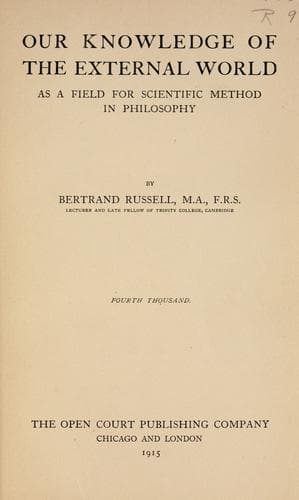
Our Knowledge of the External World as a Field for Scientific Method in PhilosophyRussell, Bertrand
Philosophy
Our Knowledge of the External World as a Field for Scientific Method in Philosophy
Russell, Bertrand
Knowledge, Theory of; Logical atomism
The argument against continuity, in so far as it rests upon the supposed
difficulties of infinite numbers, has been disposed of by the positive
theory of the infinite, which will be considered in Lecture VII. But
there remains a feeling--of the kind that led Zeno to the contention
that the arrow in its flight is at rest--which suggests that points and
instants, even if they are infinitely numerous, can only give a jerky
motion, a succession of different immobilities, not the smooth
transitions with which the senses have made us familiar. This feeling is
due, I believe, to a failure to realise imaginatively, as well as
abstractly, the nature of continuous series as they appear in
mathematics. When a theory has been apprehended logically, there is
often a long and serious labour still required in order to _feel_ it: it
is necessary to dwell upon it, to thrust out from the mind, one by one,
the misleading suggestions of false but more familiar theories, to
acquire the kind of intimacy which, in the case of a foreign language,
would enable us to think and dream in it, not merely to construct
laborious sentences by the help of grammar and dictionary. It is, I
believe, the absence of this kind of intimacy which makes many
philosophers regard the mathematical doctrine of continuity as an
inadequate explanation of the continuity which we experience in the
world of sense.
In the present lecture, I shall first try to explain in outline what the
mathematical theory of continuity is in its philosophically important
essentials. The application to actual space and time will not be in
question to begin with. I do not see any reason to suppose that the
points and instants which mathematicians introduce in dealing with space
and time are actual physically existing entities, but I do see reason to
suppose that the continuity of actual space and time may be more or less
analogous to mathematical continuity. The theory of mathematical
continuity is an abstract logical theory, not dependent for its validity
upon any properties of actual space and time. What is claimed for it is
that, when it is understood, certain characteristics of space and time,
previously very hard to analyse, are found not to present any logical
difficulty. What we know empirically about space and time is
insufficient to enable us to decide between various mathematically
possible alternatives, but these alternatives are all fully intelligible
and fully adequate to the observed facts. For the present, however, it
will be well to forget space and time and the continuity of sensible
change, in order to return to these topics equipped with the weapons
provided by the abstract theory of continuity.
Public-domain text, read in full here on John Shaqi.
Reviews
Reviews
No reviews yet
Be the first to share your thoughts on this work.
Elsewhere in the archive
Join the Discussion
Join the discussion
Sign in to leave a comment or review.
Sign InorCreate an account