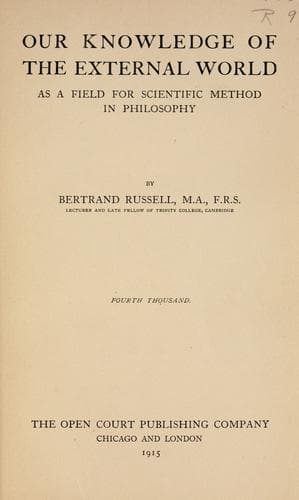
Our Knowledge of the External World as a Field for Scientific Method in PhilosophyRussell, Bertrand
Philosophy
Our Knowledge of the External World as a Field for Scientific Method in Philosophy
Russell, Bertrand
Knowledge, Theory of; Logical atomism
Continuity, in mathematics, is a property only possible to a _series_ of
terms, _i.e._ to terms arranged in an order, so that we can say of any
two that one comes _before_ the other. Numbers in order of magnitude,
the points on a line from left to right, the moments of time from
earlier to later, are instances of series. The notion of order, which is
here introduced, is one which is not required in the theory of cardinal
number. It is possible to know that two classes have the same number of
terms without knowing any order in which they are to be taken. We have
an instance of this in such a case as English husbands and English
wives: we can see that there must be the same number of husbands as of
wives, without having to arrange them in a series. But continuity, which
we are now to consider, is essentially a property of an order: it does
not belong to a set of terms in themselves, but only to a set in a
certain order. A set of terms which can be arranged in one order can
always also be arranged in other orders, and a set of terms which can be
arranged in a continuous order can always also be arranged in orders
which are not continuous. Thus the essence of continuity must not be
sought in the nature of the set of terms, but in the nature of their
arrangement in a series.
Mathematicians have distinguished different degrees of continuity, and
have confined the word "continuous," for technical purposes, to series
having a certain high degree of continuity. But for philosophical
purposes, all that is important in continuity is introduced by the
lowest degree of continuity, which is called "compactness." A series is
called "compact" when no two terms are consecutive, but between any two
there are others. One of the simplest examples of a compact series is
the series of fractions in order of magnitude. Given any two fractions,
however near together, there are other fractions greater than the one
and smaller than the other, and therefore no two fractions are
consecutive. There is no fraction, for example, which is next after 1/2:
if we choose some fraction which is very little greater than 1/2, say
51/100 we can find others, such as 101/200, which are nearer to 1/2.
Thus between any two fractions, however little they differ, there are an
infinite number of other fractions. Mathematical space and time also
have this property of compactness, though whether actual space and time
have it is a further question, dependent upon empirical evidence, and
probably incapable of being answered with certainty.
Public-domain text, read in full here on John Shaqi.
Reviews
Reviews
No reviews yet
Be the first to share your thoughts on this work.
Elsewhere in the archive
Join the Discussion
Join the discussion
Sign in to leave a comment or review.
Sign InorCreate an account