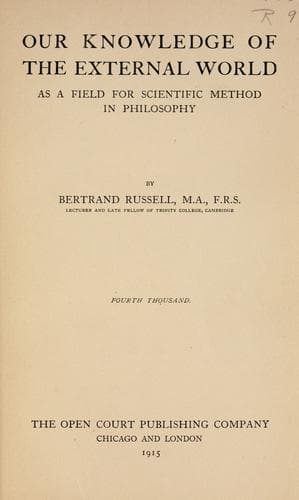
Our Knowledge of the External World as a Field for Scientific Method in PhilosophyRussell, Bertrand
Philosophy
Our Knowledge of the External World as a Field for Scientific Method in Philosophy
Russell, Bertrand
Knowledge, Theory of; Logical atomism
In the case of abstract objects such as fractions, it is perhaps not
very difficult to realise the logical possibility of their forming a
compact series. The difficulties that might be felt are those of
infinity, for in a compact series the number of terms between any two
given terms must be infinite. But when these difficulties have been
solved, the mere compactness in itself offers no great obstacle to the
imagination. In more concrete cases, however, such as motion,
compactness becomes much more repugnant to our habits of thought. It
will therefore be desirable to consider explicitly the mathematical
account of motion, with a view to making its logical possibility felt.
The mathematical account of motion is perhaps artificially simplified
when regarded as describing what actually occurs in the physical world;
but what actually occurs must be capable, by a certain amount of logical
manipulation, of being brought within the scope of the mathematical
account, and must, in its analysis, raise just such problems as are
raised in their simplest form by this account. Neglecting, therefore,
for the present, the question of its physical adequacy, let us devote
ourselves merely to considering its possibility as a formal statement of
the nature of motion.
In order to simplify our problem as much as possible, let us imagine a
tiny speck of light moving along a scale. What do we mean by saying that
the motion is continuous? It is not necessary for our purposes to
consider the whole of what the mathematician means by this statement:
only part of what he means is philosophically important. One part of
what he means is that, if we consider any two positions of the speck
occupied at any two instants, there will be other intermediate positions
occupied at intermediate instants. However near together we take the two
positions, the speck will not jump suddenly from the one to the other,
but will pass through an infinite number of other positions on the way.
Every distance, however small, is traversed by passing through all the
infinite series of positions between the two ends of the distance.
Public-domain text, read in full here on John Shaqi.
Reviews
Reviews
No reviews yet
Be the first to share your thoughts on this work.
Elsewhere in the archive
Join the Discussion
Join the discussion
Sign in to leave a comment or review.
Sign InorCreate an account