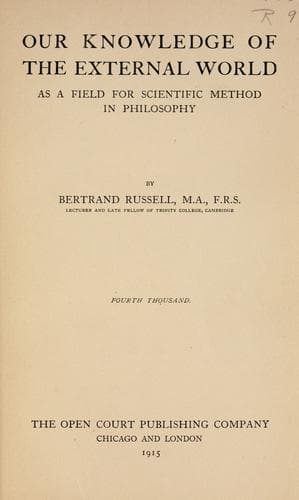
Our Knowledge of the External World as a Field for Scientific Method in PhilosophyRussell, Bertrand
Philosophy
Our Knowledge of the External World as a Field for Scientific Method in Philosophy
Russell, Bertrand
Knowledge, Theory of; Logical atomism
But at this point imagination suggests that we may describe the
continuity of motion by saying that the speck always passes from one
position at one instant to _the next_ position at _the next_ instant. As
soon as we say this or imagine it, we fall into error, because there is
no _next_ point or _next_ instant. If there were, we should find Zeno's
paradoxes, in some form, unavoidable, as will appear in our next
lecture. One simple paradox may serve as an illustration. If our speck
is in motion along the scale throughout the whole of a certain time, it
cannot be at the same point at two consecutive instants. But it cannot,
from one instant to the next, travel further than from one point to the
next, for if it did, there would be no instant at which it was in the
positions intermediate between that at the first instant and that at the
next, and we agreed that the continuity of motion excludes the
possibility of such sudden jumps. It follows that our speck must, so
long as it moves, pass from one point at one instant to the next point
at the next instant. Thus there will be just one perfectly definite
velocity with which all motions must take place: no motion can be faster
than this, and no motion can be slower. Since this conclusion is false,
we must reject the hypothesis upon which it is based, namely that there
are consecutive points and instants.[18] Hence the continuity of motion
must not be supposed to consist in a body's occupying consecutive
positions at consecutive times.
[18] The above paradox is essentially the same as Zeno's argument of
the stadium which will be considered in our next lecture.
The difficulty to imagination lies chiefly, I think, in keeping out the
suggestion of _infinitesimal_ distances and times. Suppose we halve a
given distance, and then halve the half, and so on, we can continue the
process as long as we please, and the longer we continue it, the smaller
the resulting distance becomes. This infinite divisibility seems, at
first sight, to imply that there are infinitesimal distances, _i.e._
distances so small that any finite fraction of an inch would be greater.
This, however, is an error. The continued bisection of our distance,
though it gives us continually smaller distances, gives us always
_finite_ distances. If our original distance was an inch, we reach
successively half an inch, a quarter of an inch, an eighth, a sixteenth,
and so on; but every one of this infinite series of diminishing
distances is finite. "But," it may be said, "_in the end_ the distance
will grow infinitesimal." No, because there is no end. The process of
bisection is one which can, theoretically, be carried on for ever,
without any last term being attained. Thus infinite divisibility of
distances, which must be admitted, does not imply that there are
distances so small that any finite distance would be larger.
Public-domain text, read in full here on John Shaqi.
Reviews
Reviews
No reviews yet
Be the first to share your thoughts on this work.
Elsewhere in the archive
Join the Discussion
Join the discussion
Sign in to leave a comment or review.
Sign InorCreate an account