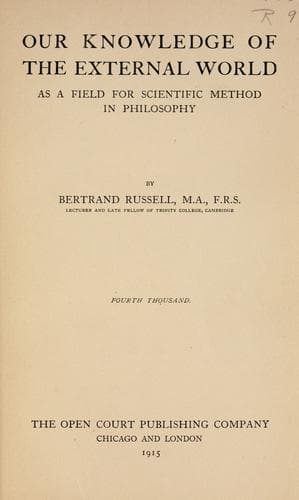
Our Knowledge of the External World as a Field for Scientific Method in PhilosophyRussell, Bertrand
Philosophy
Our Knowledge of the External World as a Field for Scientific Method in Philosophy
Russell, Bertrand
Knowledge, Theory of; Logical atomism
It is easy, in this kind of question, to fall into an elementary logical
blunder. Given any finite distance, we can find a smaller distance; this
may be expressed in the ambiguous form "there is a distance smaller than
any finite distance." But if this is then interpreted as meaning "there
is a distance such that, whatever finite distance may be chosen, the
distance in question is smaller," then the statement is false. Common
language is ill adapted to expressing matters of this kind, and
philosophers who have been dependent on it have frequently been misled
by it.
In a continuous motion, then, we shall say that at any given instant the
moving body occupies a certain position, and at other instants it
occupies other positions; the interval between any two instants and
between any two positions is always finite, but the continuity of the
motion is shown in the fact that, however near together we take the two
positions and the two instants, there are an infinite number of
positions still nearer together, which are occupied at instants that are
also still nearer together. The moving body never jumps from one
position to another, but always passes by a gradual transition through
an infinite number of intermediaries. At a given instant, it is where it
is, like Zeno's arrow;[19] but we cannot say that it is at rest at the
instant, since the instant does not last for a finite time, and there is
not a beginning and end of the instant with an interval between them.
Rest consists in being in the same position at all the instants
throughout a certain finite period, however short; it does not consist
simply in a body's being where it is at a given instant. This whole
theory, as is obvious, depends upon the nature of compact series, and
demands, for its full comprehension, that compact series should have
become familiar and easy to the imagination as well as to deliberate
thought.
[19] See next lecture.
Public-domain text, read in full here on John Shaqi.
Reviews
Reviews
No reviews yet
Be the first to share your thoughts on this work.
Elsewhere in the archive
Join the Discussion
Join the discussion
Sign in to leave a comment or review.
Sign InorCreate an account