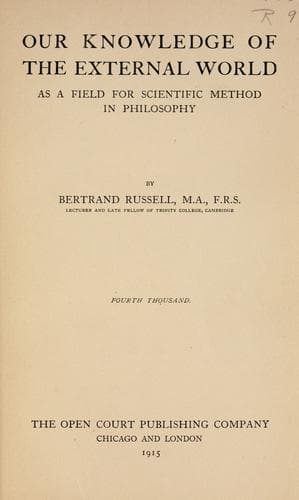
Our Knowledge of the External World as a Field for Scientific Method in PhilosophyRussell, Bertrand
Philosophy
Our Knowledge of the External World as a Field for Scientific Method in Philosophy
Russell, Bertrand
Knowledge, Theory of; Logical atomism
What is required may be expressed in mathematical language by saying
that the position of a moving body must be a continuous function of the
time. To define accurately what this means, we proceed as follows.
Consider a particle which, at the moment _t_, is at the point P. Choose
now any small portion P1P2 of the path of the particle, this portion
being one which contains P. We say then that, if the motion of the
particle is continuous at the time _t_, it must be possible to find two
instants _t_1, _t_2, one earlier than _t_ and one later, such that
throughout the whole time from _t_1 to _t_2 (both included), the
particle lies between P1 and P2. And we say that this must still hold
however small we make the portion P1P2. When this is the case, we say
that the motion is continuous at the time _t_; and when the motion is
continuous at all times, we say that the motion as a whole is
continuous. It is obvious that if the particle were to jump suddenly
from P to some other point Q, our definition would fail for all
intervals P1P2 which were too small to include Q. Thus our definition
affords an analysis of the continuity of motion, while admitting points
and instants and denying infinitesimal distances in space or periods in
time.
P1 P P2 Q
------|----|----|----|------>
Philosophers, mostly in ignorance of the mathematician's analysis, have
adopted other and more heroic methods of dealing with the _primâ facie_
difficulties of continuous motion. A typical and recent example of
philosophic theories of motion is afforded by Bergson, whose views on
this subject I have examined elsewhere.[20]
[20] _Monist_, July 1912, pp. 337-341.
Apart from definite arguments, there are certain feelings, rather than
reasons, which stand in the way of an acceptance of the mathematical
account of motion. To begin with, if a body is moving at all fast, we
_see_ its motion just as we see its colour. A _slow_ motion, like that
of the hour-hand of a watch, is only known in the way which mathematics
would lead us to expect, namely by observing a change of position after
a lapse of time; but, when we observe the motion of the second-hand, we
do not merely see first one position and then another--we see something
as directly sensible as colour. What is this something that we see, and
that we call visible motion? Whatever it is, it is _not_ the successive
occupation of successive positions: something beyond the mathematical
theory of motion is required to account for it. Opponents of the
mathematical theory emphasise this fact. "Your theory," they say, "may
be very logical, and might apply admirably to some other world; but in
this actual world, actual motions are quite different from what your
theory would declare them to be, and require, therefore, some different
philosophy from yours for their adequate explanation."
Public-domain text, read in full here on John Shaqi.
Reviews
Reviews
No reviews yet
Be the first to share your thoughts on this work.
Elsewhere in the archive
Join the Discussion
Join the discussion
Sign in to leave a comment or review.
Sign InorCreate an account