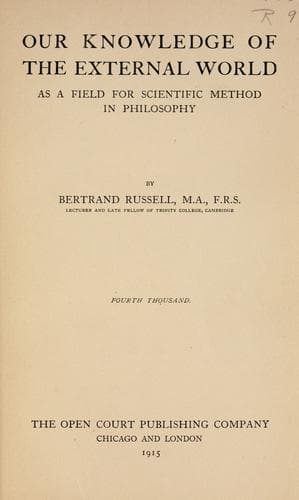
Our Knowledge of the External World as a Field for Scientific Method in PhilosophyRussell, Bertrand
Philosophy
Our Knowledge of the External World as a Field for Scientific Method in Philosophy
Russell, Bertrand
Knowledge, Theory of; Logical atomism
The objection thus raised is one which I have no wish to underrate, but
I believe it can be fully answered without departing from the methods
and the outlook which have led to the mathematical theory of motion. Let
us, however, first try to state the objection more fully.
If the mathematical theory is adequate, nothing happens when a body
moves except that it is in different places at different times. But in
this sense the hour-hand and the second-hand are equally in motion, yet
in the second-hand there is something perceptible to our senses which is
absent in the hour-hand. We can see, at each moment, that the
second-hand _is moving_, which is different from seeing it first in one
place and then in another. This seems to involve our seeing it
simultaneously in a number of places, although it must also involve our
seeing that it is in some of these places earlier than in others. If,
for example, I move my hand quickly from left to right, you seem to see
the whole movement at once, in spite of the fact that you know it begins
at the left and ends at the right. It is this kind of consideration, I
think, which leads Bergson and many others to regard a movement as
really one indivisible whole, not the series of separate states imagined
by the mathematician.
To this objection there are three supplementary answers, physiological,
psychological, and logical. We will consider them successively.
(1) The physiological answer merely shows that, if the physical world is
what the mathematician supposes, its sensible appearance may
nevertheless be expected to be what it is. The aim of this answer is
thus the modest one of showing that the mathematical account is not
impossible as applied to the physical world; it does not even attempt to
show that this account is necessary, or that an analogous account
applies in psychology.
Public-domain text, read in full here on John Shaqi.
Reviews
Reviews
No reviews yet
Be the first to share your thoughts on this work.
Elsewhere in the archive
Join the Discussion
Join the discussion
Sign in to leave a comment or review.
Sign InorCreate an account