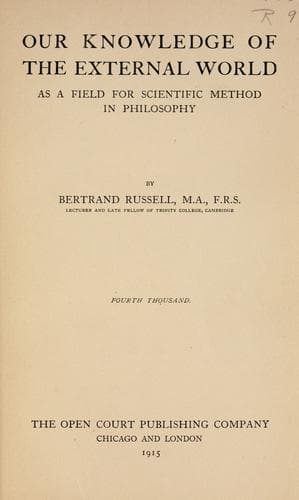
Our Knowledge of the External World as a Field for Scientific Method in PhilosophyRussell, Bertrand
Philosophy
Our Knowledge of the External World as a Field for Scientific Method in Philosophy
Russell, Bertrand
Knowledge, Theory of; Logical atomism
When any nerve is stimulated, so as to cause a sensation, the sensation
does not cease instantaneously with the cessation of the stimulus, but
dies away in a short finite time. A flash of lightning, brief as it is
to our sight, is briefer still as a physical phenomenon: we continue to
see it for a few moments after the light-waves have ceased to strike the
eye. Thus in the case of a physical motion, if it is sufficiently swift,
we shall actually at one instant see the moving body throughout a finite
portion of its course, and not only at the exact spot where it is at
that instant. Sensations, however, as they die away, grow gradually
fainter; thus the sensation due to a stimulus which is recently past is
not exactly like the sensation due to a present stimulus. It follows
from this that, when we see a rapid motion, we shall not only see a
number of positions of the moving body simultaneously, but we shall see
them with different degrees of intensity--the present position most
vividly, and the others with diminishing vividness, until sensation
fades away into immediate memory. This state of things accounts fully
for the perception of motion. A motion is _perceived_, not merely
_inferred_, when it is sufficiently swift for many positions to be
sensible at one time; and the earlier and later parts of one perceived
motion are distinguished by the less and greater vividness of the
sensations.
This answer shows that physiology can account for our perception of
motion. But physiology, in speaking of stimulus and sense-organs and a
physical motion distinct from the immediate object of sense, is assuming
the truth of physics, and is thus only capable of showing the physical
account to be possible, not of showing it to be _necessary_. This
consideration brings us to the psychological answer.
Public-domain text, read in full here on John Shaqi.
Reviews
Reviews
No reviews yet
Be the first to share your thoughts on this work.
Elsewhere in the archive
Join the Discussion
Join the discussion
Sign in to leave a comment or review.
Sign InorCreate an account