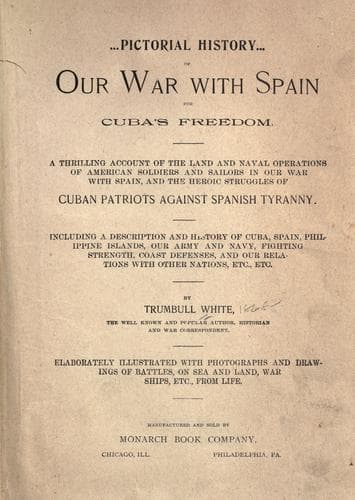
Our War with Spain for Cuba's FreedomWhite, Trumbull
History
Our War with Spain for Cuba's Freedom
White, Trumbull
Cuba -- History; Spain -- Foreign relations -- United States; Spanish-American War, 1898; United States -- Foreign relations -- Spain
The disqualifications of the Cubans to hold public office is
purely a myth. Such disqualifications is found on the text of no
law or regulation, and in point of fact there is no such
exclusion. In order to verify this assertion it would be
sufficient to examine the lists of Cuban officers, especially of
those employed in the administration of justice and in all
branches of instruction. Even if it were desired to make a
comparison of political offices, even of those connected with the
functions which are discharged in the Peninsula, the proportion
would still be shown in which Spaniards in Cuba aspire to both.
The fact is that a common fallacy is appealed to in the language
habitually used by the enemies of Spain, who call persons
"Peninsulars" who were not born in Cuba, but have resided there
many years and have all their ties and interests there, and do not
call those "Cubans" who were born there and have left the island
in order to meet necessities connected, perhaps, with their
occupation. This was done in the Senate, when the advocates of the
separation of Cuba only were called "Cubans," while those only who
refused allegiance to the Spanish mother-country were called
patriots.
In conclusion, I will relate a fact which may appear to be a joke,
but which, in a certain way, furnished proof of what I have just
said. When Rafael Gasset returned from Habana, he came and asked
me for some data showing the proportion of Cubans holding office
under our Government. I asked him, as a preliminary question, for
a definition of what we were to understand by "Cuban" and what by
"Peninsular." He immediately admitted that the decision of the
whole question was based upon that definition, and I called his
attention to the fact that here, in the Ministry of the Colonies,
at the present time, there are three high governmental
functionaries. One is a representative from Habana, being at the
same time a professor in its University, and another, viz., your
humble servant, is a Spaniard because he was born in Habana
itself. Is the other man a Peninsular, and am I not a Cuban?
GUILLERMO. Assistant Colonial Secretary of Spain.
This is the argument from the Peninsular standpoint, and it is
probably made in good faith. But while the Spanish rule in Cuba
may seem to be just and equitable in theory, it is oppressive and
tyrannical in fact. While the government may have partly carried
out the letter of its promises, there has been no effort to
fulfill the spirit of the compact in the slighest degree, and the
violated pledges of the treaty of Zanjon only add new chapters to
the long record of Spanish treachery and deceit.
CHAPTER XVI.
PREPARATIONS FOR ANOTHER REBELLION.
Spain's Policy of Distrust--The Cost of the Ten Years' War--Work
of the Cuban Exiles--Revolutionary Clubs in the Western
Hemisphere--An Expedition Checked--Heroism of Cuban Women--The
Struggle Begun.
Public-domain text, read in full here on John Shaqi.
Reviews
Reviews
No reviews yet
Be the first to share your thoughts on this work.
Elsewhere in the archive
Join the Discussion
Join the discussion
Sign in to leave a comment or review.
Sign InorCreate an account