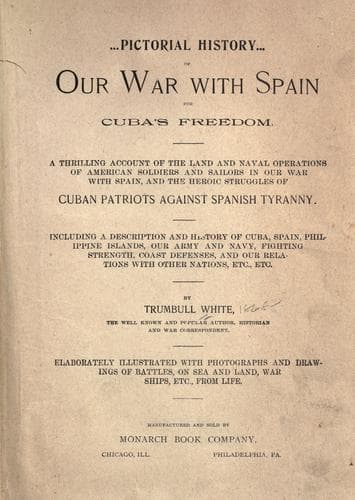
Our War with Spain for Cuba's FreedomWhite, Trumbull
History
Our War with Spain for Cuba's Freedom
White, Trumbull
Cuba -- History; Spain -- Foreign relations -- United States; Spanish-American War, 1898; United States -- Foreign relations -- Spain
Ever since Spain lost her colonies on the American continent the
Cubans have striven to gain their independence. The Ten Years War
cost the mother country 300,000,000 pesetas and 100,000 men, most
of them victims of yellow fever. When slavery was abolished in
1880 fresh disturbances ensued. The majority of slave holders, who
received no compensation, joined the party of independence.
Spain, adhering to her old policy of distrust, retained a large
army in Cuba and a navy round about her shores, the expenses of
which caused the budget to amount to $46,594,000 at a time when
two-thirds of the island was nothing but a mass of ruins, and when
Cuba was beginning to feel the effects of the competition with
other sugar-producing countries.
While the European manufacturers received important bounties those
of Cuba had to pay export duties on their sugar, and the
importation of all agricultural and industrial implements was
subjected to a tariff almost prohibitive.
Two laws were enacted in 1882 to regulate commerce between Cuba
and Spain. By the provisions of these laws the import duties on
all Spanish products were to be gradually diminished until their
importation in Cuba became entirely free, while the Cubans had to
pay on their imports to Spain duties which practically closed the
Spanish market to all their products.
Spanish goods, as a rule, are much inferior to those of English,
French or American manufacture, but the Cuban consumer was forced
to buy Spanish goods or pay an exorbitant price for those which he
would have preferred to buy at a fair price. An instance will
suffice to illustrate this: When the present war began in 1895 the
duty on a hundred kilogrammes of woolen cashmere was fifteen
dollars and forty-seven cents if Spanish, three hundred dollars
if foreign. These differential duties opened a reign of prosperity
for industry in Spain, where foreign goods were imported or
smuggled, to be later sent to Cuba as Spanish.
The injustice of these commercial laws was so evident and so
detrimental to the interests of Cuba that in 1894 the Planters'
Association, the president of which, the Count de Diana, was a
Spaniard, referred to them as "destructive of our public wealth, a
source of inextinguishable discontent and the germ of serious
dissensions."
The insular budgets could never be covered, and the result was
that the public debt was kept on the increase. The expenditures
were classed as follows: For army and navy, 36.59 per cent of the
budget's total; for the debt, 40.89; for justice and government,
19.77, and for public works, 2.75. No public work of any kind was
begun in the seventeen years which intervened between the two
wars.
Public-domain text, read in full here on John Shaqi.
Reviews
Reviews
No reviews yet
Be the first to share your thoughts on this work.
Elsewhere in the archive
Join the Discussion
Join the discussion
Sign in to leave a comment or review.
Sign InorCreate an account