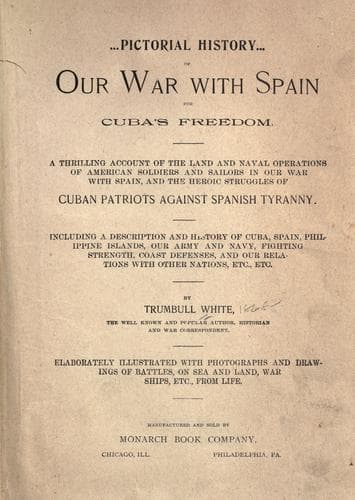
Our War with Spain for Cuba's FreedomWhite, Trumbull
History
Our War with Spain for Cuba's Freedom
White, Trumbull
Cuba -- History; Spain -- Foreign relations -- United States; Spanish-American War, 1898; United States -- Foreign relations -- Spain
"I do not see how it could even be put into operation by force,
because as long as the insurgents decline to accept it, so long,
the Spanish authorities say, the war must continue."
General Lee then describes the efforts to form an autonomistic
cabinet in Cuba and the public disapprobation of the people.
On January 8 General Lee makes the following report:
"Sir--I have the honor to state, as a matter of public interest, that
the reconcentrado order of General Weyler, formerly governor-general of
this island, transformed about four hundred thousand self-supporting
people, principally women and children, into a multitude to be sustained
by the contributions of others, or die of starvation or of fevers
resulting from a low physical condition and being massed in large
bodies, without change of clothing and without food.
"Their homes were burned, their fields and plant beds destroyed,
and their live stock driven away or killed.
"I estimate that probably two hundred thousand of the rural
population in the provinces of Pinar del Rio, Havana, Matanzas,
and Santa Clara have died of starvation or from resultant causes,
and the deaths of whole families almost simultaneously, or within
a few days of each other, and of mothers praying for their
children to be relieved of their horrible sufferings by death are
not the least of the many pitiable scenes which were ever present.
In the provinces of Puerto Principe and Santiago de Cuba, where
the 'reconcentrado order' could not be enforced, the great mass of
the people are self-sustaining. ...
"A daily average of ten cents' worth of food to two hundred
thousand people would be an expenditure of $20,000 per day, and,
of course, the most humane efforts upon the part of our citizens
cannot hope to accomplish such a gigantic relief, and a great
portion of these people will have to be abandoned to their fate." ...
On January 12, 13, 14 and 15 General Lee sent brief cablegrams to
the department in regard to those rioting and the demonstrations
against autonomy and Blanco and the three newspaper offices.
January 13 he said some of the rioters threatened to go to the
United States consulate. "Ships," he said, "are not needed, but
may be later. If Americans are in danger ships should move
promptly for Havana. Uncertainty and excitement widespread." The
rioting ceased the next day and General Lee reported all quiet.
On March 1 General Lee reports that the distribution of food,
medicines, and clothing to the destitute is proceeding
satisfactorily. The work, he says, has been well organized and
systematized under the supervision and direction of Miss Clara
Barton, president of the Red Cross of the United States, and her
active, able, and experienced assistant. He inclosed a letter on
March 14 from Consul Barker, of Sagua, who requests him to
transmit the following letter, which is addressed to him (General
Lee):
Public-domain text, read in full here on John Shaqi.
Reviews
Reviews
No reviews yet
Be the first to share your thoughts on this work.
Elsewhere in the archive
Join the Discussion
Join the discussion
Sign in to leave a comment or review.
Sign InorCreate an account