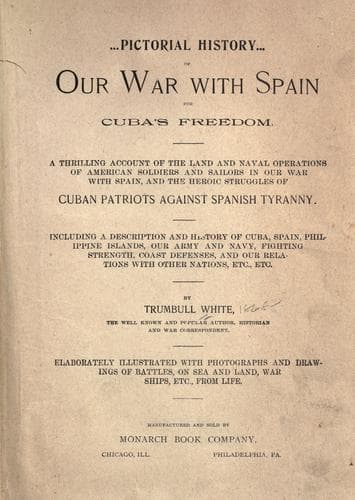
Our War with Spain for Cuba's FreedomWhite, Trumbull
History
Our War with Spain for Cuba's Freedom
White, Trumbull
Cuba -- History; Spain -- Foreign relations -- United States; Spanish-American War, 1898; United States -- Foreign relations -- Spain
Neutral ships, however, are entitled to some sort of warning that
a blockade exists. Notice is therefore sent to all neutral
governments, announcing the fact and stating exactly the extent of
coast covered. Besides this, until the blockade has lasted for
some time and thus has become generally known it is customary for
the officers of the blockading fleet to visit and warn every ship
that approaches, the warning, with the date, being entered upon
her register. If, after that, she approaches the forbidden coast,
she is liable to confiscation--though possibly great stress of
weather might excuse her provided she landed no cargo.
Instructions of this sort were issued by President McKinley to our
squadron blockading Cuba. A reasonable time, also, was granted to
ships that were lying in the blockaded ports at the time when the
blockade was declared, to make their escape. President McKinley
allowed thirty days for this purpose, which was unusually liberal.
Nations engaged in war have sometimes assumed that they could
establish a blockade by simply issuing a proclamation forbidding
neutrals to approach the enemy's coast, without stationing ships
to enforce it. For example, during the Napoleonic wars, France
declared the whole coast of England to be blockaded at a time when
she scarcely dared send out a ship from her ports, having been
soundly thrashed at Trafalgar. But these "paper blockades" are a
mere waste of time and ink. They are not valid, and except in the
way of angry and contemptuous protest, no nation would consider
them worthy of the slightest attention. If Spain, for instance,
should attempt a desperate game of bluff by declaring New Orleans,
New York and Boston under blockade, all neutral ships would come
and go just the same, and she would meddle with them at her peril.
This question--if it ever was a question--was finally decided by
the epoch-making convention of the powers at the close of the
Crimean war (treaty of Paris, 1856), which, along with other rules
that have revolutionized naval warfare, declared that "blockades
in order to be binding must be effective." This means that they
must be maintained by a force actually stationed on the blockaded
coast, strong enough to make it decidedly dangerous to attempt to
run through. The temporary absence of some of the ships, however,
either in pursuit of an enemy or on account of a violent storm,
would not invalidate the blockade, and ships seeking to take
advantage of such an opening would be liable to the full penalty
if caught.
And now a few words about "prizes"--a particularly interesting and
timely theme, for during the very first week of the war our fleet
captured no fewer than fifteen of them.
Public-domain text, read in full here on John Shaqi.
Reviews
Reviews
No reviews yet
Be the first to share your thoughts on this work.
Elsewhere in the archive
Join the Discussion
Join the discussion
Sign in to leave a comment or review.
Sign InorCreate an account