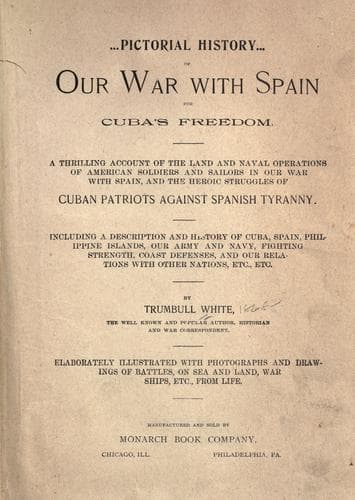
Our War with Spain for Cuba's FreedomWhite, Trumbull
History
Our War with Spain for Cuba's Freedom
White, Trumbull
Cuba -- History; Spain -- Foreign relations -- United States; Spanish-American War, 1898; United States -- Foreign relations -- Spain
He and his wife were befriended by the Emperor Ferdinand of
Austria, who placed the young Don Carlos under the care of a
Spanish priest, who educated him for the priesthood. Even in his
infancy he cared nothing to become a priest in spite of his devout
devotion to the Roman Catholic faith, but dreamed of the day when
he would rule as King of Spain.
Don Carlos was only seventeen years of age when he met and fell in
love with Margaret, the daughter of the Duke of Parma. She was
only fourteen, and the mother of the young prince persuaded them
to postpone the marriage for three years. With his wife the
pretender received a large fortune and he has been able to
maintain a court in the semblance of royalty for several years.
Thirty years ago Carlos might have been king. The crown was then
offered him by Prim and Sagasta, who journeyed to London for the
purpose. They said it should be his if he would support the
liberal constitution proposed for the country and would favor the
separation of church and state. It was the latter idea that led to
his rejection of the proffered honor. His strict Roman Catholic
training made him refuse, for religion was more to him than
anything else.
CARLOS' SCORNFUL REFUSAL.
"When I come to my throne," he declared, "I shall rule my land as
I see fit."
These were the words with which he scornfully spurned their offer.
The republicans never forgave him, and later when, after the
dethronement of Isabella, his name was again proposed in the
cortes by his supporters, Prim and Sagasta were his most bitter
enemies.
On Don Carlos' behalf, insurrections--speedily repressed--took
place in 1869 and 1872. But the insurrection headed by him in
person in 1873 proved much more formidable and kept the Basque
provinces in a great confusion till the beginning of 1876, when it
was crushed.
Before the commencement of the war of 1872-76, Don Carlos defined
clearly his position and views in various manifestos addressed to
the people of Spain. He declared that with him the revolutionary
doctrine should have no place. What Spain wanted, said Don Carlos,
was that no outrage should be offered to the faith of her fathers,
for in Catholicity reposed the truth, as she understood it, the
symbol of all her glories, the spirit of all her laws and the bond
of concord between all good Spaniards. What Spain wanted was a
real king and a government worthy and energetic, strong and
respected.
The opportunity for Don Carlos was found in the troublous times
that led to and followed the abdication of Amadeo I., Duke of
Aosta, who had been elected by the cortes. The four years' war
commenced in spring, 1872, and a year later Amadeo abdicated in a
message saying that he saw Spain in a continual struggle, and the
era, of peace more distant; he sought remedies within the law, but
did not find them; his efforts were sterile.
Public-domain text, read in full here on John Shaqi.
Reviews
Reviews
No reviews yet
Be the first to share your thoughts on this work.
Elsewhere in the archive
Join the Discussion
Join the discussion
Sign in to leave a comment or review.
Sign InorCreate an account