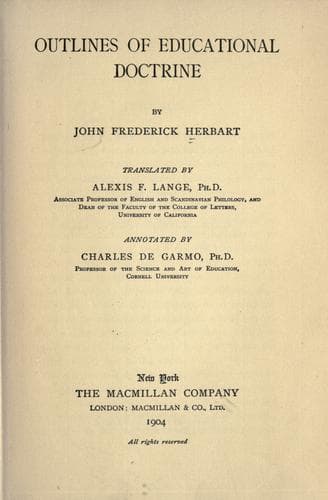
Outlines of Educational DoctrineHerbart, Johann Friedrich
Philosophy
Outlines of Educational Doctrine
Herbart, Johann Friedrich
Education -- Philosophy
193. It is evident from the wide divergence among the principles which
schools old and new have accepted as the basis of ethics and of systems
of justice, that many conflicting, or at any rate, one-sided views may
arise when the attempt is made to introduce order, definiteness, and
consistency into existing ethical concepts. This whole conflict and
one-sidedness of opinion, together with the innumerable fluctuations
that may find a place here besides,--all this is likely to be
reproduced in youthful minds, particularly where they make it a point
of going their own way. Very frequently acquired principles adjust
themselves to inclinations; the subjective side of character adapts
itself to the objective. Now, while it is the business of instruction
to correct error, training must avail itself of those opportunities
that reveal a directing of thoughts by inclination.
194. When, however, the pupil has once established confidence
in his disposition as well as in his principles, training must
withdraw. Unnecessary judging and over-anxious observation would only
impair naturalness, and give rise to extraneous motives. When once
self-culture has been assumed, it should be left alone.
SECTION IV
SYNOPSIS OF GENERAL PEDAGOGICS FROM THE POINT OF VIEW OF AGE
CHAPTER I
=The First Three Years=
195. Owing to the delicate character of the thread of life during
the earliest years, care for the body, a subject falling outside the
limits of the present discussion, has precedence of everything else.
The state of health, accordingly, implies great variations in the time
available for profitable culture of the mind. But short as this time
may be, it is extremely important, because of the great receptivity and
susceptibility of the first period of life.
The lines of study suggested by these few remarks upon infancy have
been arduously pursued in recent years by Perez,[21] Preyer,[22]
Baldwin,[23] and others. The attempt has been made in these works
to show how the psychical and physical powers of the young child
actually unfold. In this way it has been possible to correct many
erroneous deductions from adult psychology, thus making elementary
training more successful.
[21] Perez, “The First Three Years of Childhood.”
[22] Preyer, (a) “Mental Development in the Child,” (b) “The
Development of the Intellect,” (c) “The Senses and the Will.”
[23] Baldwin, (a) “Mental Development in the Child and the Race,”
(b) “Social and Ethical Interpretations.”
196. Those moments when the child is fully awake and free from
suffering should always be utilized by presenting, but not obtruding,
something for sense-perception. Powerful impressions are to be avoided.
The same caution applies to violent changes; very slight variations
often suffice to revive waning attention. It is desirable to secure a
certain completeness of eye- and ear-impressions, so that the senses
may be equally at home everywhere within the fields of sight and sound.
Public-domain text, read in full here on John Shaqi.
Reviews
Reviews
No reviews yet
Be the first to share your thoughts on this work.
Elsewhere in the archive
Join the Discussion
Join the discussion
Sign in to leave a comment or review.
Sign InorCreate an account