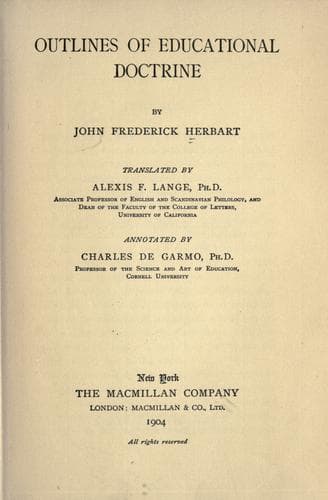
Outlines of Educational DoctrineHerbart, Johann Friedrich
Philosophy
Outlines of Educational Doctrine
Herbart, Johann Friedrich
Education -- Philosophy
197. As far as safety permits, the spontaneous activity of the child
should have free play, primarily that he may get practice in the use of
every limb, but also in order that by his own attempts his observations
of objects and their changeableness may be enlarged.
198. Unpleasant, repellent impressions of persons, whoever they are,
must be most carefully guarded against. No one can be allowed to treat
a child as a plaything.
199. On the other hand, no one must allow himself to be ruled by a
child, least of all when the child becomes importunate. Otherwise,
wilfulness will be the inevitable consequence, a result almost
unavoidable with sickly children, by reason of the attention demanded
by their sufferings.
200. A child must always feel the superiority of adults, and often his
own helplessness. The necessary obedience is founded on this feeling.
With consistent treatment, persons constantly about the child will
secure obedience more readily than others who are rarely present.
Outbursts of passion must be given time to subside unless circumstances
urgently require a different course.
201. On rare occasions there may be an exhibition of force inspiring
enough fear to make a threat effective and to check an excess of animal
spirits. For if government is to escape the extremely harmful necessity
of severe disciplinary measures later on, it must become firmly
established during the earliest years of childhood.
202. The language of children demands scrupulous attention from the
beginning, in order to prevent the formation of incorrect and careless
habits of speech, which at a later period it usually requires much
trouble and loss of time to eradicate. But literary forms of expression
that are beyond the comprehension of children are to be strictly
avoided.
CHAPTER II
=The Ages from Four to Eight=
203. The real boundary line is fixed not by age, but by that stage of
development when the helplessness of the first stage is superseded by
control of the limbs and a connected use of language. And the mere
fact that children are now able to free themselves from much momentary
discomfort carries with it greater calmness and cheerfulness.
204. In proportion as the child learns to help himself, assistance from
without must be withdrawn. At the same time government must increase
in firmness, and with many children in severity, until the last traces
of that wilfulness vanish, which the former period does not as a rule
wholly escape. But this presupposes that no one provoke the child
unnecessarily to any kind of resistance. The firmer the established
order of things about the child, the readier his compliance.
205. The child must be given as much freedom as circumstances will
permit, one purpose being to induce frank self-expression, and to
obtain data for a study of his individuality. Still, the main thing
at this age is to guard against bad habits, especially such as are
connected with objectionable tendencies of disposition.
Public-domain text, read in full here on John Shaqi.
Reviews
Reviews
No reviews yet
Be the first to share your thoughts on this work.
Elsewhere in the archive
Join the Discussion
Join the discussion
Sign in to leave a comment or review.
Sign InorCreate an account