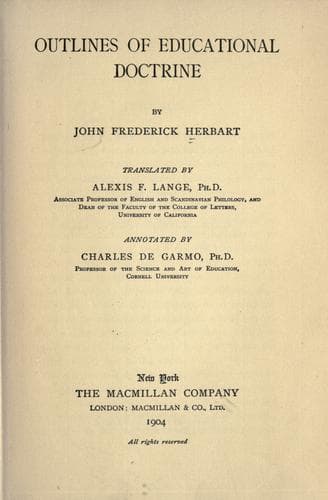
Outlines of Educational DoctrineHerbart, Johann Friedrich
Philosophy
Outlines of Educational Doctrine
Herbart, Johann Friedrich
Education -- Philosophy
206. Two of the ethical ideas concern us here directly, each, however,
in its own way. They are the ideas of good-will and perfection. Some
particular aspects of the latter a child will almost always hit upon
himself. The former less often springs up spontaneously; it has to be
implanted, and this cannot always be done directly.
207. The ill-will, which many children exhibit frequently, is always
a bad sign,--one that needs to be treated very seriously. A character
once perverted in this respect can no longer be radically changed
for the better. And this perversion sometimes begins very early. The
steps to be taken in this connection are determined by the following
considerations:--
208. In the first place, younger children are not to be left alone very
much. Their life should be a social life, and their social circle one
subject to strict order. This requirement fulfilled, all manifestations
of ill-will are at variance with the rule; and as soon as they appear,
the child finds himself opposed by the existing state of things. Now,
the more he has grown accustomed to participation in the common will,
to occupying his time, and being happy within its pale, the less will
he be able to bear the feeling of isolation. To punish a child for an
exhibition of ill-will, leave him alone.
209. But such punishment presupposes the undiminished sensitiveness of
the younger child, who, on being left alone, begins to cry, and feels
utterly helpless and weak, but who, on the other hand, becomes cheerful
again the moment he is readmitted into the social circle. If this
period has been neglected, if the ill-disposed child has already caused
aversion in the circle in which he could have been happy, one feeling
of ill-will begets another in return, and nothing remains but to insist
on strict justice.
210. The mere social spirit which keeps ill-will at a distance, is, of
course, very far from being good-will; children are even prone to look
upon descriptive illustrations of the latter, in the ordinary run of
books for children, as fables easily invented. Hence the first thing
to make sure of is faith in good-will. We have in mind here especially
the child who through force of habit has lost his appreciation of the
kindnesses constantly showered upon him in the course of his education.
Deprive him of some of the care to which he is accustomed; its renewal
will then make him recognize and prize it as a voluntary act. When,
on the contrary, children regard what is being done for them as their
right, or as the effect of some sort of mechanism, this blunder of
theirs becomes a fruitful source of the most manifold moral evils.
Public-domain text, read in full here on John Shaqi.
Reviews
Reviews
No reviews yet
Be the first to share your thoughts on this work.
Elsewhere in the archive
Join the Discussion
Join the discussion
Sign in to leave a comment or review.
Sign InorCreate an account