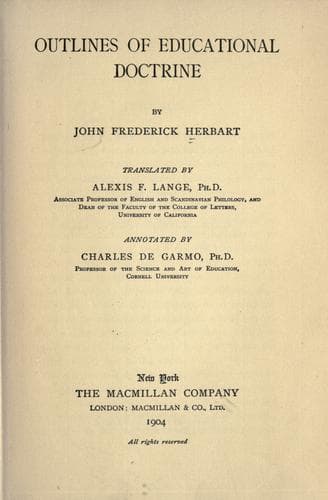
Outlines of Educational DoctrineHerbart, Johann Friedrich
Philosophy
Outlines of Educational Doctrine
Herbart, Johann Friedrich
Education -- Philosophy
211. To the union of kindness with the necessary degree of severity, we
must add friendliness, lest the heart of the child become chilled, and
the germs of good-will perish. During the period under consideration,
the child’s frame of mind is still determined directly by the treatment
he receives. Continued unfriendliness of manner produces dull
indifference. The twofold problem of lifting the idea of good-will into
adequate prominence and of actually awakening sentiments of good-will
can, it is true, not be solved as early as childhood. But much has been
gained if sympathy, supported by sociable cheerfulness, unites with a
belief in the good-will of those on whom the child feels dependent, as
if they were higher beings. The soil is ready now for religious culture
and its furthering influences.
212. The idea of perfection in its universal aspect is indeed as
foreign to the child’s mind as that of good-will; nevertheless, the
rudiments of what this idea implies can be imparted with far greater
assurance of success. As the child grows and thrives, his strength
and accomplishments increase likewise, and he takes pleasure in his
own progress. But here innumerable differences in kind and in degree
demand our observation, particularly in view of the purpose of linking
instruction to the stage of growth. For it is during this period that
synthetic as well as analytic instruction begins, although it does not
as yet normally constitute the chief occupation of the child.
213. As the child’s sphere of free activity widens and his own
attempts create a growing store of experiences, which the teacher will
often find it very necessary to augment by purposely showing him about,
the earlier fancies are gradually being overbalanced by experiential
knowledge, although different individuals may exhibit great variations
of ratio. From this impulse to appropriate the new, spring the numerous
questions children put to the teacher, on the tacit assumption that he
is omniscient. They are the outcome of the mood of the moment, they are
purposeless, and most of them do not recur if not answered then and
there. Many of them concern words alone, and cease on mention of some
suitable designation of the object in question. Others relate to the
connection of events, especially to motives underlying the actions of
human beings, fictitious and real alike. Now, although many questions
cannot, while others must not, be answered, the tendency to ask
questions should, generally speaking, receive constant encouragement as
a sign of native interest, of the absence of which the teacher often
becomes painfully aware later on without being able by any skill on his
part to revive it. Here an opportunity is presented for preparing the
ground in many directions for future instruction. Only, the teacher
has to refrain, in answering questions, from the prolixity of untimely
thoroughness; what he ought to do is to sail on the waves of childish
fancy.
Public-domain text, read in full here on John Shaqi.
Reviews
Reviews
No reviews yet
Be the first to share your thoughts on this work.
Elsewhere in the archive
Join the Discussion
Join the discussion
Sign in to leave a comment or review.
Sign InorCreate an account