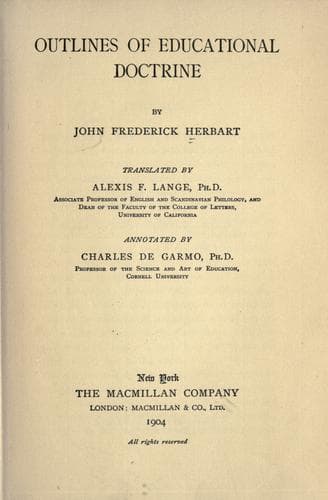
Outlines of Educational DoctrineHerbart, Johann Friedrich
Philosophy
Outlines of Educational Doctrine
Herbart, Johann Friedrich
Education -- Philosophy
And this does not usually lend itself to experiments; its
movements are, on the contrary, often inconveniently capricious.
214. So long as there can be no fixed time for the analytic lessons
woven into answers to the questions of children, analytic instruction
is coincident with the guidance of the child’s attention, with his
social intercourse, with his occupations and the consequent cultivation
of habits, with hardening exercises, ethical judgments, and the
earliest religious impressions; in some measure also with reading
exercises.
215. To the latter portion of this period belong the first steps in
synthetic instruction, reading, writing, ciphering, the simplest modes
of arrangement, and the first observation exercises. If the child
is as yet incapable of uniform attention during a whole hour, the
teacher will be satisfied with smaller divisions of time; the degree of
attention is more important than its duration.
Note that the subjects enumerated fall into different groups. Counting,
arranging, observing, are different phases of the natural development
of the mind. Instruction does not create these activities; its business
is merely to accelerate them. At the beginning, therefore, our mode
of procedure must be as much as possible analytic. On the other hand,
reading and writing can be taught only synthetically, although on the
basis of an antecedent analysis of speech sounds.
(1) Arranging--commonly neglected, though wrongly so--is an
exceedingly easy exercise in itself, and facilitates the performance of
many other tasks. It is therefore appropriate for children. That three
objects may change places from right to left (from front to rear, from
above to below) and _vice versa_--this is the beginning. The next step
is to show that three objects admit of six permutations in a straight
line. To find how many pairs can be formed out of a given number of
objects, is one of the easiest problems. How far to go, is a matter to
be determined by circumstances. Not letters, however, but objects,--the
children themselves,--should be changed about, permuted, and varied in
position. The teaching of a subject like this must in a measure have
the semblance of play.
(2) The first observation exercises begin with straight lines drawn
vertically or cross-wise. Use may be made also of knitting needles
variously placed, side by side or across each other, of domino checks,
and of similar objects. Next comes the circle, subdivided and presented
in manifold ways.
(3) For arithmetic, likewise, concrete objects are needed,--coins,
for example, which are counted and arranged in different groups to
illustrate sums, differences, and products. At first the highest number
employed should not exceed, say, twelve or twenty.
Public-domain text, read in full here on John Shaqi.
Reviews
Reviews
No reviews yet
Be the first to share your thoughts on this work.
Elsewhere in the archive
Join the Discussion
Join the discussion
Sign in to leave a comment or review.
Sign InorCreate an account