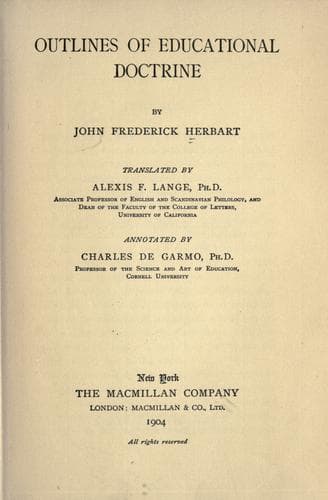
Outlines of Educational DoctrineHerbart, Johann Friedrich
Philosophy
Outlines of Educational Doctrine
Herbart, Johann Friedrich
Education -- Philosophy
(4) For work in reading we may avail ourselves of letters and numbers
printed on cards, which lend themselves to a variety of arrangements.
If children are slow about learning to read, the blunder must not be
made of neglecting their mental culture in other directions, as though
reading were its necessary prerequisite. Reading often demands a large
amount of patience, and should never be allowed to produce a feeling of
aversion to teachers and books.
(5) Writing is ushered in by the elementary drawing that must accompany
observation exercises. Writing itself, when once well started, furthers
reading.
216. But already at this point many fall behind. Puzzled at first by
the demand upon them for the dull labor of learning, they surrender
themselves later on to the feeling of incapacity. In large schools,
where there are always some outstripping the rest, and where the
majority are trying to keep up with the pace set, performance can be
had more readily, although it is performance by imitation rather than
by an inner sequence of thought. And even here we find thoroughly
disheartened laggards.
CHAPTER III
=Boyhood=
217. The boundary line between boyhood and early childhood is fixed, so
far as this is possible at all, by the fact that the boy, if allowed to
do so, will leave the company of adults. Formerly he felt insecure when
left alone: now he considers himself fairly well acquainted with his
immediate environment, beyond which vistas of all sorts are opening.
Accordingly, at this stage it becomes incumbent on the adult to attach
himself to the boy, to restrain him, to divide the time for him, and
to circumscribe the fancies born of his self-confidence,--a course of
action rendered all the more necessary by the circumstance that the boy
is a stranger as yet to the timidity with which the youth joins the
ranks of men. For boyhood is marked off from adolescence by this, that
the boy’s aims are still unsettled; he plays and takes no thought of
to-morrow. Moreover, his dream of manhood is one of arbitrary power.
The play-impulse remains active for a long time, unless checked by
conventionality.
During this period, the work of linking instruction to sense-impression
is by no means to be omitted entirely, not even where fair progress
has already been made in scholarship. We must make sure of a solid
foundation.
Public-domain text, read in full here on John Shaqi.
Reviews
Reviews
No reviews yet
Be the first to share your thoughts on this work.
Elsewhere in the archive
Join the Discussion
Join the discussion
Sign in to leave a comment or review.
Sign InorCreate an account