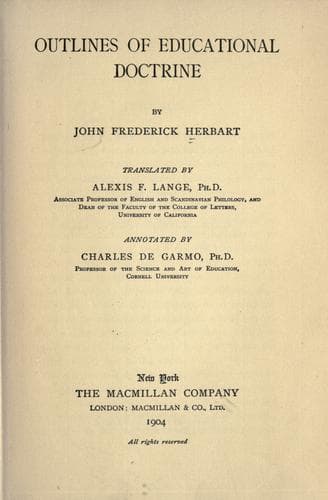
Outlines of Educational DoctrineHerbart, Johann Friedrich
Philosophy
Outlines of Educational Doctrine
Herbart, Johann Friedrich
Education -- Philosophy
218. Our chief concern during the age of boyhood must be to prevent
the premature fixation of the circle of ideas. It is for instruction
to undertake the task of doing so. True, by far the greatest part of
the process of learning, however manifold, is performed through the
interpretation of words, the pupil supplying the meaning out of the
mental store collected previously. But this very fact obviously implies
that quantitively the pupil’s stock of ideas is for the most part
complete; instruction merely works it up into new forms. Accordingly,
such shaping must take place while the material is still in a plastic
state; for with increasing years it gradually assumes a more solid
character.
219. Boys differ from girls, individuals differ from one another;
and the subjects taught, together with the methods of teaching them,
should be differentiated accordingly. But here the family interposes
the interests of rank or station, and claims the right to determine by
these how much or how little instruction a boy needs.
Looked at pedagogically, each study calls for a corresponding mental
activity to be suited to the general condition of the individual. Its
success must not involve exhaustion of the pupil’s powers, nor make
demands upon them at the wrong time.
But it would be an error to argue that one who is being initiated
into one subject ought to combine with that subject a second, third,
or fourth, on the ground that subjects one, two, three, and four are
essentially interrelated. This conclusion holds for scholars, who,
so far as they are personally concerned, have long passed beyond
preliminary pedagogical considerations, and even in their case it
applies only to those branches which are intimately connected with
their specialties; it has nothing to do with the psychological
conditions by which the course of education must be governed. Only too
frequently do masses of ideas remain isolated despite the fact that
the objects corresponding to them are most intimately and necessarily
interconnected; and such isolation could not have been prevented by
merely starting work in a large web of erudition in a number of places.
The case is different where certain studies constitute the necessary
preparation for thorough knowledge of one kind or another. Here we are
right in concluding that one who cannot master the former is equally
unable to get hold of the latter.[24]
[24] These remarks upon correlation are instructive in view of later
developments of the Herbartian school in Germany. The reader is
referred to discussions in the First and Second Year-Books of the
National Herbart Society.
Public-domain text, read in full here on John Shaqi.
Reviews
Reviews
No reviews yet
Be the first to share your thoughts on this work.
Elsewhere in the archive
Join the Discussion
Join the discussion
Sign in to leave a comment or review.
Sign InorCreate an account