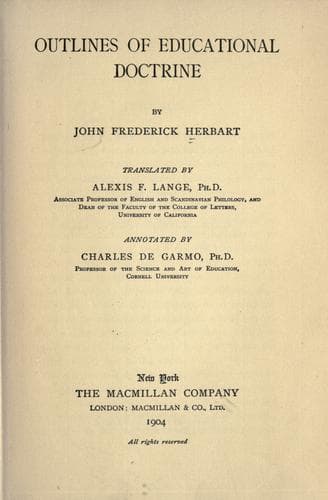
Outlines of Educational DoctrineHerbart, Johann Friedrich
Philosophy
Outlines of Educational Doctrine
Herbart, Johann Friedrich
Education -- Philosophy
220. It is difficult to deal with the rare instances of tardy
development unless we find that they are due to neglected health,
or to lack of assistance in enlarging the range of experience, and
to failure to change the mode of instruction. Here an attempt may be
made to supply what is wanting. But even where the rate of progress
becomes more rapid at once, the teacher’s efforts will have turned
out favorably only when the boy gives also clear proof of a vigorous
striving for advancement.
221. To revert to fundamental ethical principles, particular mention of
the ideas of justice and equity needs to be made in this connection.
These ideas issue from reflection on human relations; they are
consequently less accessible to early childhood, which finds itself
subordinated everywhere to the family. The boy, on the other hand,
lives more among his peers, and the necessary corrections are not
always administered so promptly as to leave no time for independent
judgment. Not infrequently voluntary association takes place among
boys, personal authority plays a part, and even usurpation of power is
not rare. Now, education has to provide for clear ethical concepts and
for government and training besides. But not only that; it must also
furnish the kind of instruction that will exhibit similar but remote
relations, for purposes of unbiassed contemplation. Such instruction
must borrow its material from poetry and history.
222. To history we are referred by still another consideration. As
has already been shown (206–211), the idea of good-will points to
the necessity of religious culture; and this relies for support on
stories, old stories at that. The expansion of the pupil’s power of
thought which is here demanded must be generally attained, even though
very incompletely, in every course of instruction, that of the village
school included.
223. Another fixed goal, the importance of which exceeds even that of
reading and writing, is furnished by arithmetic, which gives clearness
to the common concepts of experience, and is indispensable in the
practical affairs of life.
Public-domain text, read in full here on John Shaqi.
Reviews
Reviews
No reviews yet
Be the first to share your thoughts on this work.
Elsewhere in the archive
Join the Discussion
Join the discussion
Sign in to leave a comment or review.
Sign InorCreate an account