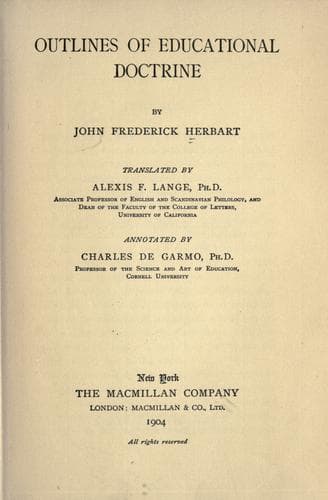
Outlines of Educational DoctrineHerbart, Johann Friedrich
Philosophy
Outlines of Educational Doctrine
Herbart, Johann Friedrich
Education -- Philosophy
224. Decimal arithmetic no pupil would be likely to think out by
himself; he would very certainly not invent Bible history. Both must
accordingly be regarded as belonging preëminently to the province of
synthetic instruction, which always involves the difficult problem of
how to assure its entrance, as a potent factor, into existing masses
of ideas. As to this, it would be a blunder to conclude that, since
Bible history and history as a whole, arithmetic and mathematics as
a whole, hang together, there is also a corresponding pedagogical
connection (219). But so much is certain, that the efficiency of
a group of ideas increases with expansion and with multiplied
association. It will be an advantage, therefore, to Bible history
and to arithmetic, if as wide a range is given to historical and
mathematical teaching as circumstances and ability permit, even if
the conditions should be such that a many-sided culture is not to be
expected.
225. The subjects next to be considered in the choice of material for
instruction are poetry and natural history, great care being taken
not to disregard the necessary sequence. The time for fables and
stories should not be curtailed; it is important to make sure that
boys do not lose the taste for them too early. The easiest and safest
facts of zoölogy will have been presented already in connection with
the picture-books of childhood. The right moment for introducing the
elements of botany has arrived when the boy is collecting plants.
Foreign languages would be assigned the lowest place, if particular
circumstances did not in many cases lend them a special importance.
The ancient classical languages, at any rate, form to such an extent
the basis of the study of theology, of jurisprudence, and of medicine,
they are so necessary to all higher scholarship, that they will
always constitute the fundamental branches of instruction in academic
preparatory schools.
It is obvious, however, that the extent of instruction depends too
much on external conditions of rank and means to permit a definite
prescription of instruction-material for all cases. Far less dependent
is the development of many-sided interest in its relation to branches
of study. If the limits set to the latter are narrow, it is still the
business of instruction to secure an approximation to many-sided
culture; while under highly favorable circumstances the very abundance
of educational help must put the teacher on his guard against losing
sight of the real aim of instruction.
Public-domain text, read in full here on John Shaqi.
Reviews
Reviews
No reviews yet
Be the first to share your thoughts on this work.
Elsewhere in the archive
Join the Discussion
Join the discussion
Sign in to leave a comment or review.
Sign InorCreate an account