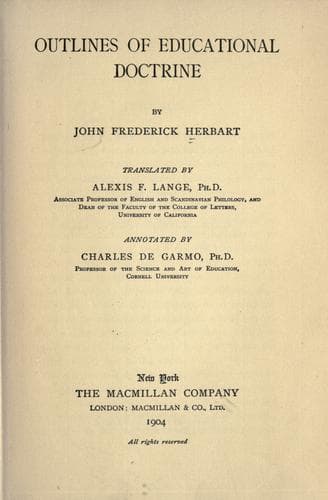
Outlines of Educational DoctrineHerbart, Johann Friedrich
Philosophy
Outlines of Educational Doctrine
Herbart, Johann Friedrich
Education -- Philosophy
226. Frequently the burden of necessary and useful studies is made
excessively heavy, a fact which the members of the teaching profession
try to conceal from themselves, but which attracts the attention of
outsiders. A few hours of gymnastics do not sufficiently counteract
such evil effects. As an offset we have at best the prevention of
the vices of idleness. From every point of view, for the mere reason
that this matter calls for special attention and that the method of
procedure has to be determined in accordance with the results of
observation, the home must do its part toward relieving that natural
strain which even good instruction exerts--and the school must not
encroach on the time necessary for that purpose. In extreme cases, to
be sure, it may be expressly demanded that the school engage the whole
of a boy’s time. But, as a rule, outside school-work should take up,
not the largest, but, on the contrary, the smallest amount of time
possible. How the remaining hours are to be employed is for parents
and guardians to decide according to individual needs, ascertained
by observation; and it is on them that the responsibility for the
consequences rests.
CHAPTER IV
=Youth=
227. Whether instruction comes to an end or is continued during
this period, all it can accomplish depends now on the fulfilment
of the condition that the young man himself regard the retention
and increase of his attainments as something valuable. Accordingly,
the interrelations of knowledge, as well as its connection with
action, must be brought before his mind with the greatest possible
distinctness. He must be furnished, also, with the strongest incentives
to reach the goal determined upon, provided the question is merely how
to overcome indolence and thoughtlessness. For it is just at this stage
that the teacher needs to fear and to prevent those wrong motives which
would issue merely in an artificial semblance of talent.
228. Moreover, the allowance made for the child and the boy can no
longer be made for the youth. His whole ability is to be put to the
test, and his position in human society determined according to the
outcome. He must experience something of the difficulty of obtaining
a foothold among men. Positions for which he does not seem quite
prepared are contested; he is surrounded by rivals, and is spurred
on by expectations, which it is often difficult to moderate when most
necessary.
229. If now the young man puts his trust in favorable circumstances,
and, in spite of all appeals, gives himself up to the pursuit of ease
and pleasure, education is at an end. It only remains to conclude with
precepts and representations which future experiences may possibly
recall.
Public-domain text, read in full here on John Shaqi.
Reviews
Reviews
No reviews yet
Be the first to share your thoughts on this work.
Elsewhere in the archive
Join the Discussion
Join the discussion
Sign in to leave a comment or review.
Sign InorCreate an account