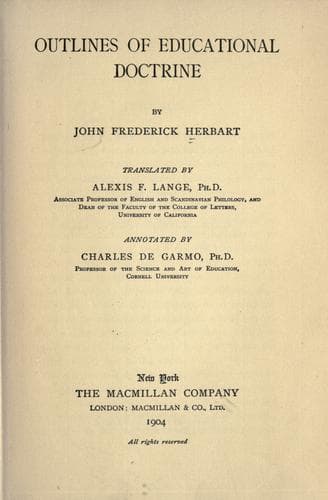
Outlines of Educational DoctrineHerbart, Johann Friedrich
Philosophy
Outlines of Educational Doctrine
Herbart, Johann Friedrich
Education -- Philosophy
230. If, on the other hand, the youth has his eyes fixed on a definite
goal, the form of life which he is striving to attain, and the motives
that impel him, will determine what else may be done for him. According
as the ideals of honor that he makes his own are directed more
outwardly or inwardly, they stand more or less midway between plans for
actions and maxims.
231. The youth is no longer pliant, except when his failures have made
him feel ashamed of himself. Such cases must be made use of for the
purpose of making good deficiencies. But on the whole, duty requires
that the stern demands of morality be held up to him without disguise.
Perfect frankness can hardly be looked for any longer, and to insist
on it is out of the question entirely. The reserve of the age of
adolescence marks the natural beginning of self-control.
These brief paragraphs on the development of the individual through
infancy, childhood, boyhood, and youth, mark an early interest
in what is now known as child-study, the literature of which has
become voluminous. For a dissertation on the experimental study of
children, and a bibliography of the subject, the reader is referred
to the monograph by Arthur McDonald, of the United States Bureau of
Education, entitled “Experimental Study of Children.” A smaller but
more useful bibliography has been compiled by L. N. Wilson. It is
found in _Pedagogical Seminary_ for September, 1899.
PART III
_SPECIAL APPLICATIONS OF PEDAGOGICS_
SECTION I
REMARKS ON THE TEACHINGS OF PARTICULAR BRANCHES OF STUDY
CHAPTER I
=Religion=
232. The content of religious instruction is for theologians to
determine, while philosophy bears witness that no knowledge is able to
surpass the trust of religious faith. But both the beginning and the
end of religious instruction call for remarks from the point of view of
pedagogy.
Religious instruction culminates, if it does not end, in the rite of
confirmation, and the subsequent admission to the Holy Communion. The
former is characteristic of a particular Christian denomination; the
latter, on the contrary, of the whole brotherhood of Christians.
Now the profound emotion which marks the first Communion service
should imply a conquest over the feeling of separation from other
denominations, especially since the mere admission to Communion is
conditioned on the general requirement of earnest ethical aspiration.
It is thus assumed that members of other confessions, provided they are
communicants at all, have fulfilled the same condition. Preparatory
instruction must work toward this end all the more, since with many
persons Christian love for those who differ from them in important
articles of faith belongs to the more difficult duties. Moreover, the
fact that this same instruction necessarily had to set forth clearly
fundamental denominational differences, lends additional weight to the
necessity of inculcating the virtue of Christian charity.
Public-domain text, read in full here on John Shaqi.
Reviews
Reviews
No reviews yet
Be the first to share your thoughts on this work.
Elsewhere in the archive
Join the Discussion
Join the discussion
Sign in to leave a comment or review.
Sign InorCreate an account