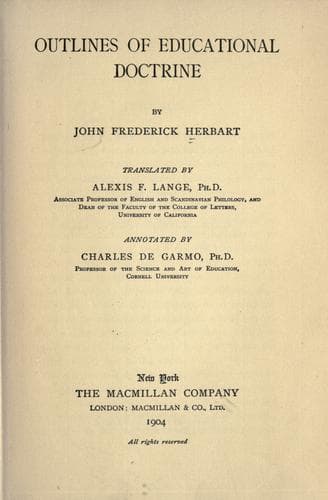
Outlines of Educational DoctrineHerbart, Johann Friedrich
Philosophy
Outlines of Educational Doctrine
Herbart, Johann Friedrich
Education -- Philosophy
233. In academic schools, if Greek is begun early enough, it is
possible to deepen the impressions of Christian teaching by the
dialogues of Plato that bear on the death of Socrates, particularly
the “Crito” and the “Apology.” Being the weaker, however, impressions
of this sort should precede the time when the solemn initiation into
Christian fellowship produces its whole powerful effect.
234. Going back in thought, we find that the portion of religious
instruction which deals with characteristic denominational
distinctions, presupposes that which deals with tenets common to all
Christians, and we find that this in turn has been preceded by Bible
stories, including those of the Old Testament. But the question arises,
“Must we not go back to something more fundamental still?”
235. Religion cannot possibly be adequately presented by treating of it
merely as a perpetuation of something historical and past. The teacher
must needs make use also of the present testimony furnished by the
adjustment of means to end, in nature. But even this, for which some
knowledge of nature is prerequisite, and which leads up to the ideas of
wisdom and power, is not the first step.
236. True family feeling is elevated easily and directly to the idea
of the Father, of the father and mother. Only where such feeling is
wanting does it become necessary to make churches and Sunday observance
the starting-point as indications of humility and gratitude. An
all-pervading love, providence, and watchful care constitute the first
concept of the Highest Being,--a concept limited by the mental horizon
of the child, and expanding and becoming more elevated only by degrees.
237. The process of elevating religious concepts and purifying them
of unworthy admixtures must, however, have taken place, and the true
concepts must have been deeply impressed, before the mythological
conceptions of antiquity become known; in which case the latter will
produce the right effect by the contrast between the manifestly
fabulous and crude, and the worthy and sublime. If managed properly,
this subject presents no difficulties.
Public-domain text, read in full here on John Shaqi.
Reviews
Reviews
No reviews yet
Be the first to share your thoughts on this work.
Elsewhere in the archive
Join the Discussion
Join the discussion
Sign in to leave a comment or review.
Sign InorCreate an account