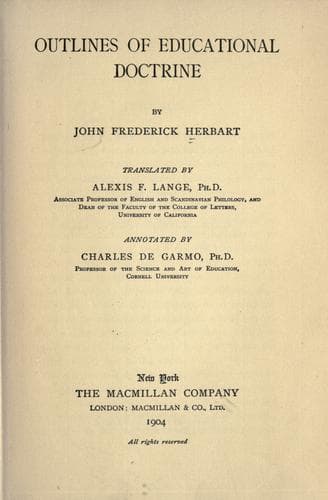
Outlines of Educational DoctrineHerbart, Johann Friedrich
Philosophy
Outlines of Educational Doctrine
Herbart, Johann Friedrich
Education -- Philosophy
238. But there are other difficulties,--difficulties growing out of
individual peculiarities. While some would be harmed by much talk
about sin, because they would thus either become acquainted with it,
or else be filled with fantastic terror, there are others whom only
the strongest language can move, and still others who themselves
preach against the sins of the world, and, at the same time, front the
world in proud security. Then there are those who brood over ethical
problems, and who, without having heard of Spinoza, argue that what the
Highest Judge has permitted to happen he has approved of, whence might
is the practical proof of right. There are contemners of mere morality,
who think that prayers will consecrate their evil actions. Isolated
traces of such perversions may indeed be met with even in children,
especially if their glib reproduction of the sermon, or worse yet,
their praying aloud, has happened to receive praise.
Hence it is necessary to observe the effect of religious instruction on
each individual. Another task for home training.
CHAPTER II
=History=
239. The most common blunder that younger teachers of history are apt
to make is that, without intending it, they become increasingly prolix
in presentation. It is not that interest deepens, but that the network
of events lures them, now one way, now another. This of itself evinces
preparation; but mental preparation alone does not suffice; preliminary
practice, too, is necessary.
Young teachers of history, like young teachers in other subjects, are
prone to error. What the prevailing error in a given study will be,
is likely to depend upon conventional methods of presenting it. In
Germany it is customary for the teacher himself to be the historian
through whose mind all historical knowledge passes on its way to
the children. But just as good writers of history are rare, so good
teachers of history are likely to be few, since in an important sense
they are at once teachers and oral historians. Where the text-book is
depended upon for the narrative, as in the United States, a different
difficulty presents itself to the teacher. What shall he do with the
text, all the pupils having read it? Perhaps the commonest method is
to call upon them one by one to reproduce it in class. But this is a
deadening process, since it compels nineteen pupils to sit passive
while the twentieth recites the words that the nineteen could repeat
equally well. If, therefore, the besetting fault of the teacher of
history in German is prolixity, that of the American teacher is
tediousness. The German method is that of primitive man, where the
legends of the tribe are handed down from father to son by word of
mouth; the American presentation of history is modern, where all the
resources of scholarship and the advantages of the printing press are
utilized. Each method has peculiar advantages, the former having the
Public-domain text, read in full here on John Shaqi.
Reviews
Reviews
No reviews yet
Be the first to share your thoughts on this work.
Elsewhere in the archive
Join the Discussion
Join the discussion
Sign in to leave a comment or review.
Sign InorCreate an account