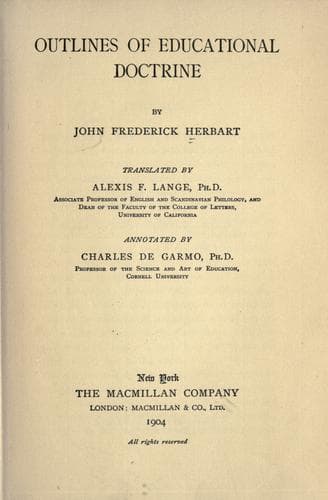
Outlines of Educational DoctrineHerbart, Johann Friedrich
Philosophy
Outlines of Educational Doctrine
Herbart, Johann Friedrich
Education -- Philosophy
possible charm of first-hand narrative, the latter that of accuracy
and comprehensiveness. The narrative method is greatly superior to
that of the text-book with children whose powers of reading are
not well developed; the text-book, together with its available
accessories, is greatly to be preferred with older pupils capable
of large amounts of reading. The following sections give a vivid
description of the narrative method at its best; the commentary will
attempt to show how the printed page may be made equally attractive,
and, at the same time, much more useful.
240. If, to begin with, a purely chronological, but accurate,
outline-view of history is to be imparted, the teacher must be able
to traverse mentally the whole historical field, going with equal
readiness back, forward, or across (synchronistically). The notable
names must form definite groups and series; and the teacher must
possess facility in making the most notable names stand out clearly
from the groups, and in condensing the most salient points of a long
series into a short series.
If this mastery of subject-matter is important for the narrator, it
is equally important for the teacher who depends upon print for the
narration. Observation of current history teaching betrays the fact
that the teacher rarely becomes master of his material to such an
extent that he can throw it into new forms. As it stands in the book,
he probably knows it; but to take liberties with the facts, to expand
parts, or throw masses into brief outline, to make new groupings, or
to change a long series into a short one, usually lies beyond his
ability. This lesson the American teacher must learn through a better
mastery of his materials.
241. Again, the teacher must make himself perfectly familiar with
general notions that relate to classes of society--constitutions,
institutions, religious customs, stages of culture--and that serve
to explain events. But not only this; he must study likewise the
conditions under which he can develop them and keep them present in
the minds of his pupils. This consideration alone shuts out most
generalizations from the first lessons in history. And, accordingly,
ancient history, whose moving causes are simpler than the more modern
political factors, maintains its place in presentations of historical
material to younger pupils.
Public-domain text, read in full here on John Shaqi.
Reviews
Reviews
No reviews yet
Be the first to share your thoughts on this work.
Elsewhere in the archive
Join the Discussion
Join the discussion
Sign in to leave a comment or review.
Sign InorCreate an account