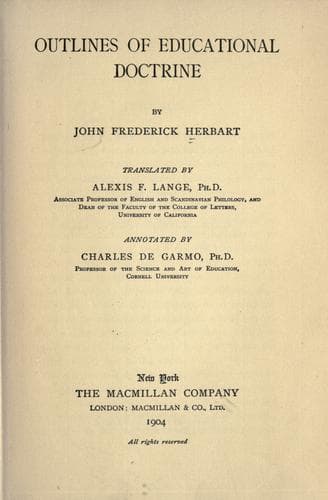
Outlines of Educational DoctrineHerbart, Johann Friedrich
Philosophy
Outlines of Educational Doctrine
Herbart, Johann Friedrich
Education -- Philosophy
American history is better than ancient history in respect to its
richness of picturesque variety. It is, moreover, easier for children
to comprehend, since our present conditions have emerged directly
from our pioneer state. Not only are constitutions, institutions,
and religious customs to be studied, but the economic conditions of
those early times are particularly worthy of study, since they are
both important and interesting. Methods of farming, of conducting
household affairs, such as cooking, making fires, producing
clothing, securing shelter, means of transportation on land and
water, methods of communication, and many other similar topics are of
interest to the young.
242. Furthermore, due attention must be given to the difficulty of
narrating well a complex event. The very first condition is continuity
of the thought-current, in order that the thread of the story may
remain unbroken, except where there are intentional rests. This, in
turn, presupposes fluency of speech, careful cultivation of which is
indispensable to a good presentation of historical events. But mere
fluency does not suffice. There must also be resting-places, because
otherwise alternate absorption and reflection cannot be secured; and
because, without such pauses, even the formation of the series fails,
since what has preceded arrests what follows. It is therefore not
immaterial where a historical lesson begins and ends, and where the
reviews are inserted.
While the narrator can utter words in succession only, the event has,
in his mind, a very different form, which it is his business to convey
to his hearers. Nor does the form of the event resemble a level plane;
on the contrary, a manifold interest lifts some things into prominence
and lets others sink. It is essential, accordingly, to distinguish how
far, in a given instance, the narration should follow in a straight
line the succession of events, and where, on the other hand, it should
deviate to include accessory circumstances. The very language used
must possess the power to induce side-glances and retrospective views,
even without leaving the main road. The narrator must have skill to
introduce descriptions here and to linger over pictures there, but must
be able also, while moving his hearers, to retain his own self-control
and to keep his bearings.
243. There remains one other requisite of prime importance, namely, the
utmost simplicity of expression. The condensed and abstract language of
more recent historians is hardly suited even to the highest class of a
secondary school; a sentimental or witty treatment, such as that found
in modern novelists, must be avoided entirely. The only safe models are
the ancient classics.
Public-domain text, read in full here on John Shaqi.
Reviews
Reviews
No reviews yet
Be the first to share your thoughts on this work.
Elsewhere in the archive
Join the Discussion
Join the discussion
Sign in to leave a comment or review.
Sign InorCreate an account