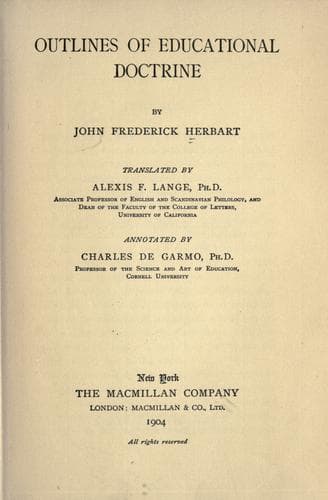
Outlines of Educational DoctrineHerbart, Johann Friedrich
Philosophy
Outlines of Educational Doctrine
Herbart, Johann Friedrich
Education -- Philosophy
Other authors reach the same ends by different means. Fiske’s
“History of the United States,” for example, concludes each chapter
with a topical outline in which cause and effect are emphasized.
At the close of Chapter X, on the “Causes and Beginning of the
Revolution,” we find the following:--
=Topics and Questions=
76. _Causes of Ill Feeling between England and her Colonies._
1. What was the European idea of a colony, and of its object?
2. What erroneous notions about trade existed?
3. What was the main object of the laws regulating trade, etc.?
77. _The Need of a Federal Union._
1. One difficulty in carrying on the French wars.
2. An account of Franklin.
3. Franklin’s plan of union, etc.
78. _The Stamp Act Passed and Repealed._
1. The kind of government needed by the colonies.
2. How Parliament sought to establish such a government.
3. The nature of a stamp act, etc.
79. _Taxation in England._
1. How Pitt’s friendship for America offended George III.
2. The representation of the English people in Parliament.
3. How the representation of the people is kept fair in the
United States.
4. How it became unfair in England.
5. Corrupt practices favored by this unfairness.
6. The party of Old Whigs.
7. The Tories, or the party of George III.
8. The party of New Whigs and its aims.
9. Why George III was so bitter against Pitt.
10. The attitude of the King toward taxation in America.
11. The people of England not our enemies, etc.
At the close of these topics there follows a list of fifteen
“Suggestive Questions and Directions,” with page references to
Fiske’s “The American Revolution,” Vol. I, the whole being concluded
by eighteen topics for collateral reading from “The American
Revolution,” and from Cooke’s “Virginia.”[26]
It is a significant fact that modern text-books for children are
being prepared by masters in the various departments of knowledge,
not a little thought being bestowed upon the highest utilization
of all modern instruments for arousing the intelligent interest of
the pupils. This being the case, it is idle to rely upon primitive
methods, however potent they may have been in the past, with pupils
who have learned to read fluently.
[25] Larned, “History of England,” Houghton, Mifflin & Co., p. 396.
[26] Fiske, John, “A History of the United States for Schools,”
Houghton, Mifflin & Co., Boston, pp. 211–215.
Public-domain text, read in full here on John Shaqi.
Reviews
Reviews
No reviews yet
Be the first to share your thoughts on this work.
Elsewhere in the archive
Join the Discussion
Join the discussion
Sign in to leave a comment or review.
Sign InorCreate an account