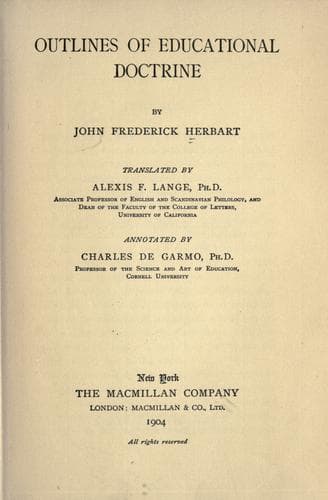
Outlines of Educational DoctrineHerbart, Johann Friedrich
Philosophy
Outlines of Educational Doctrine
Herbart, Johann Friedrich
Education -- Philosophy
248. The general surveys that follow the detailed narratives have this
advantage for the pupil: he infers of his own accord, that in periods
of which not much is told, a great deal took place, nevertheless,
which the history or the teacher passes over in silence. In this way
the false impressions are prevented that would be produced by purely
compendious instruction, which indeed, at a later stage, becomes in a
measure unavoidable.
249. (3) Mediæval history derives no assistance from the study of the
ancient languages, nor is it closely related to present conditions;
there is difficulty in imparting to the presentation of it more
than the clearness obtainable through geography and chronology. But
more than this is requisite: the burden of mere memory work without
interest would become too great. The fundamental factors, Islamism,
Papacy, the Holy Roman Empire, Feudalism, must be explained and given
due prominence. Most of the facts down to Charlemagne may be made to
contribute additional touches to the panorama of the Great Migration.
With Charlemagne the chain of German history begins, and it will
usually be considered advisable to extend this chain to the end of
the Middle Ages, in order to have something to which synchronous
events may be linked later on. Yet some doubt arises as to the value
of such a plan. To be sure, the reigns of the Ottos, the Henrys, the
Hohenstaufen, together with intervening occurrences, form a tolerably
well-connected whole; but as early as the interregnum there is a
sad break, and although the historical narrative recovers, as it
were, with the stories of Rudolph Albrecht and Ludwig the Bavarian,
there is nothing in the names of succeeding leaders, from Carl IV
to Frederick III, that would make them proper starting-points and
connecting centres for the synchronism of the whole period in question.
It might be better, therefore, to stop with the excommunication of
Ludwig the Bavarian, with the assembly of the electors at Rhense,
and with the account of how the popes came to reside in Avignon.
Then--going back to Charlemagne--France, Italy, even England, may
be taken up, and greater completeness given to the history of the
crusades. Farther on, special attention might be called, in a
synchronistic way, to Burgundy and Switzerland, and to the changing
fortunes of the wars between England and France. French history may
then leave off with the reign of Charles VIII, and English history
with that of Henry VII, while German history, from Maximilian on,
is placed again in the foreground. The Hussite wars will be treated
as forerunners of the Reformation. Other events must be skilfully
inserted. Many modifications of grouping will have to be reserved for
subsequent repetitions.
Public-domain text, read in full here on John Shaqi.
Reviews
Reviews
No reviews yet
Be the first to share your thoughts on this work.
Elsewhere in the archive
Join the Discussion
Join the discussion
Sign in to leave a comment or review.
Sign InorCreate an account