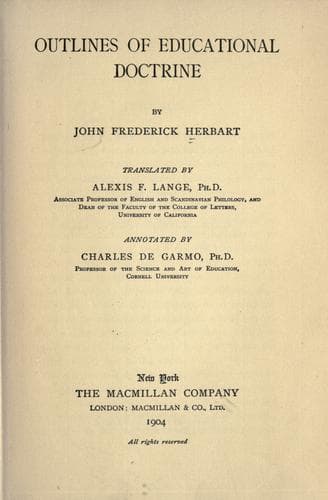
Outlines of Educational DoctrineHerbart, Johann Friedrich
Philosophy
Outlines of Educational Doctrine
Herbart, Johann Friedrich
Education -- Philosophy
250. (4) In presenting modern history, the teacher will do well to
avail himself of the fact that modern history does not cover so long
reaches of time as mediæval history does, and that it falls into
three sharply defined periods, the first of which ends with the
treaty of Westphalia, the second extends from this date to the French
Revolution, and the third, to the present. These periods should be
carefully distinguished, the leading events of each should be narrated
synchronistically, and a recital of the most essential historical facts
about each country should follow. Only after each has been handled
in this way, and the subject-matter presented has been thoroughly
impressed upon the memory by reviews, will it be well to pass on to a
somewhat fuller ethnographical account reaching back into the mediæval
history of each country and extending forward to our own times. No
harm is done by going over the same ground again for the purpose of
amplifying that which before appeared in outline only.
The chief point is, that no course of instruction which claims at all
to give completeness of culture can be regarded as concluded before it
has introduced the pupil to the pragmatic study of history, and has
taught him to look for causes and effects. This applies preëminently to
modern history, on account of its direct connection with the present;
but mediæval and ancient history, too, have to be worked over once more
from this point of view. History should be the teacher of mankind; if
it does not become so, the blame rests largely with those who teach
history in schools.
251. A well-compiled and well-proportioned brief history of inventions,
arts, and sciences should conclude the teaching of history, not only in
gymnasia, but also and especially in higher burgher schools, because
their courses of study are not supplemented by the university.
Moreover, the whole course in history is properly accompanied by
illustrative poetical selections, which, although perhaps not produced
during the different epochs, yet stand in some relation to them; and
which in some measure, even if only by illustrating ages very far
apart, exhibit the vast differences in the freest activities of the
human mind.
=Note.=--National history is not the same for each land, nor
everywhere of equal interest, and, owing to its connection with
larger events, often unintelligible to young minds when torn out
of its place and presented by itself. If its early introduction is
desired in order to kindle the heart, special pains must be taken
to select that which is intelligible and which appeals to boyhood.
CHAPTER III
=Mathematics and Nature Study=
Public-domain text, read in full here on John Shaqi.
Reviews
Reviews
No reviews yet
Be the first to share your thoughts on this work.
Elsewhere in the archive
Join the Discussion
Join the discussion
Sign in to leave a comment or review.
Sign InorCreate an account