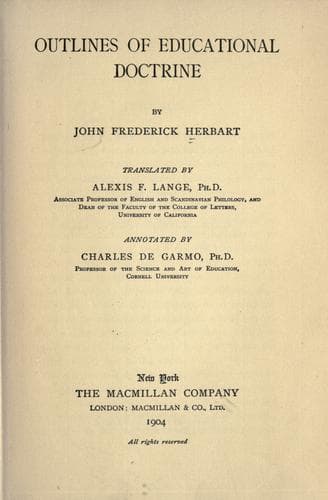
Outlines of Educational DoctrineHerbart, Johann Friedrich
Philosophy
Outlines of Educational Doctrine
Herbart, Johann Friedrich
Education -- Philosophy
252. Aptitude for mathematics is not rarer than aptitude for other
studies. That the contrary seems true, is owing to a belated and
slighted beginning. But that mathematicians are seldom inclined to
give as much time to children as they ought is only natural. The
elementary lessons in combination and geometry are neglected in favor
of arithmetic, and demonstration is attempted where no mathematical
imagination has been awakened.
The first essential is attention to magnitudes, and their changes,
where they occur. Hence, counting, measuring, weighing, where possible;
where impossible, at least the estimating of magnitudes to determine,
however vaguely at first, the more and the less, the larger and the
smaller, the nearer and the farther.
Special consideration should be given, on the one hand, to the number
of permutations, variations, and combinations; and, on the other hand,
to the quadratic and cubic relations, where similar planes and bodies
are determined by analogous lines.
=Note.=--This is not the place for saying much that might be said
concerning that which renders early instruction in mathematics
unnecessarily difficult. But it may be remarked in brief that
some of these difficulties arise from the terminology, some
from the teacher’s accustomed point of view, and some from the
multiplication of varying requirements.
(1) The phraseology used forms an obstacle, even to the easiest
steps in fractions. The fraction ⅔, for example, is read
two-thirds, and, accordingly, ⅔ × ⅘, two-thirds times four-fifths,
instead of, multiplication by two and by four, and division by
three and by five. The fact is overlooked that the third part of
a whole includes the concept of this whole, which cannot be a
multiplier, but only a multiplicand. This difficulty the pupils
stumble over. The same applies to the mysterious word _square
root_, employed instead of the expression: one of the two equal
factors of a product. Matters grow even worse later on when they
hear of roots of equations.
(2) Still more might be said in criticism of the erroneous
view according to which numbers are recorded as sums of units.
This is true as little as that sums are products; two does not
mean two things, but doubling, no matter whether that which is
doubled is one or many. The concept of a dozen chairs is not
made up of 12 percepts of single chairs; it comprises only two
mental products,--the general concept chair and the undivided
multiplication by 12. The concept one hundred men likewise contains
only two concepts,--the general concept man and the undivided
number 100. So, also, in such expression as six foot, seven pound,
in which language assists correct apprehension by the use of the
singular. Number concepts remain imperfect so long as they are
identified with series of numbers and recourse is had to successive
counting.
Public-domain text, read in full here on John Shaqi.
Reviews
Reviews
No reviews yet
Be the first to share your thoughts on this work.
Elsewhere in the archive
Join the Discussion
Join the discussion
Sign in to leave a comment or review.
Sign InorCreate an account