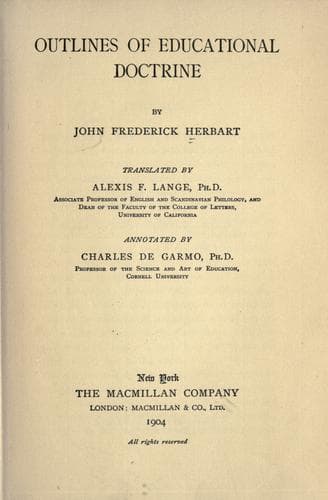
Outlines of Educational DoctrineHerbart, Johann Friedrich
Philosophy
Outlines of Educational Doctrine
Herbart, Johann Friedrich
Education -- Philosophy
(3) In arithmetical problems the difficulty attaching to the
apprehension of the things dealt with is confounded with that of
the solution itself. Principal and interest and time, velocity and
distance and time, etc., are matters which must be familiar to
the pupils, and hence must have been previously explained, long
before use can be made of them for practice. The pupil to whom
arithmetical concepts still give trouble should be given concrete
examples so familiar to him that out of them he can create over
again the mathematical notion and not be compelled to apply it to
them.
253. The measuring of lines, angles, and arcs (for which many
children’s games, constructive in tendency, may present the first
occasion) leads over to observation exercises dealing with both planes
and spheres. Skill in this direction having been attained, frequent
application must be made of it, or else, like every other acquirement,
it will be lost again. Every plan of a building, every map every
astronomical chart, may afford opportunities for practice.
These observation exercises are to be organized in such a manner that
upon the completion of mensuration the way is fully prepared for
trigonometry, provided that besides the work in plain geometry, algebra
has been carried as far as equations of the second degree.
Extended discussions as to the place and value of the ratio
idea in elementary arithmetic are found in “The Psychology of
Number,” by McLellan & Dewey,[27] and in “The New Arithmetic,”
by W. W. Speer.[28] The former work advocates early practice in
measuring with changeable units, claiming that the child should
early acquire the idea of number as the expression of the relation
that a measured somewhat bears to a chosen measurer, and making
counting a special case of measuring. Mr. Speer makes the ratio idea
still more prominent by furnishing the school with numerous sets of
blocks of various sizes and shapes with which to drill the pupils
into instantaneous recognition of number as the ratio between two
quantities. For an extended examination of these principles the
reader may well consult Dr. David Eugene Smith’s able treatise on the
teaching of elementary mathematics.[29]
Public-domain text, read in full here on John Shaqi.
Reviews
Reviews
No reviews yet
Be the first to share your thoughts on this work.
Elsewhere in the archive
Join the Discussion
Join the discussion
Sign in to leave a comment or review.
Sign InorCreate an account