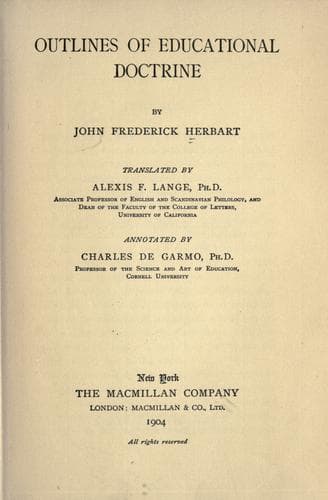
Outlines of Educational DoctrineHerbart, Johann Friedrich
Philosophy
Outlines of Educational Doctrine
Herbart, Johann Friedrich
Education -- Philosophy
=Note.=--It is now nearly forty years since the author wrote a
little book on the plan of Pestalozzi’s A, B, C, of observation,
and he has often had it used by teachers since. Numerous
suggestions have been given by others under the title, “Study of
Forms.” The main thing is training the eye in gauging distances and
angles, and combining such exercises with very simple computations.
The aim is not merely to secure keenness of observation for objects
of sense, but, preëminently, to awaken geometrical imagination and
to connect arithmetical thinking with it. Indeed, exercises of
this sort constitute the necessary, although commonly neglected,
preparation for mathematics. The helps made use of must be concrete
objects. Various things have been tried and cast aside again;
most convenient for the first steps are triangles made from thin
hard-wood boards. Of these only seventeen pairs are needed, all
of them right-angled triangles with one side equal. To find these
triangles, draw a circle with a radius of four inches, and trace
the tangents and secants at 5°, 10°, 15°, 20°, etc., to 85°.
The numerous combinations that can be made will easily suggest
themselves. The tangents and secants must be actually measured
by the pupils; from 45° on, the corresponding figures, at first
not carried out beyond tenths, should be noted, and, after some
repetition, learned by heart. On this basis very easy arithmetical
examples may be devised for the immediate purpose of gaining the
lasting attention of the pupils to matters so simple. Observations
relating to the sphere require a more complicated apparatus,
namely, three movable great circles of a globe. It would be well
to have such means at hand in teaching spherical trigonometry.
Needless to say, of course, observation exercises do not take the
place of geometry, still less of trigonometry, but prepare the
ground for these sciences. When the pupil reaches plain geometry,
the wooden triangles are put aside, and observation is subordinated
to geometrical construction. Meanwhile arithmetic is passing beyond
exercises that deal merely with proportions, to powers, roots, and
logarithms. In fact, without the concept of the square root, not
even the Pythagorean Theorem can be fully grasped.
Public-domain text, read in full here on John Shaqi.
Reviews
Reviews
No reviews yet
Be the first to share your thoughts on this work.
Elsewhere in the archive
Join the Discussion
Join the discussion
Sign in to leave a comment or review.
Sign InorCreate an account