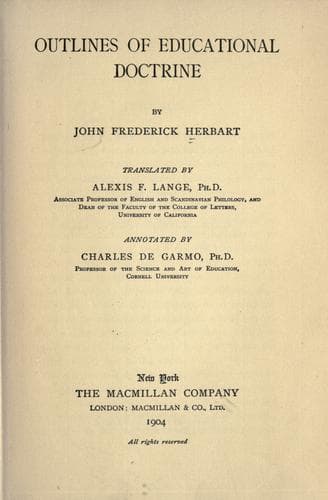
Outlines of Educational DoctrineHerbart, Johann Friedrich
Philosophy
Outlines of Educational Doctrine
Herbart, Johann Friedrich
Education -- Philosophy
“Herbart’s A, B, C, of Sense Perception,” together with a number of
minor educational works, has been translated into English.[30] It
abounds in shrewd observations and ingenious devices, yet as a whole
it represents one of those side excursions, which, though delightful
to genius, is not especially useful to the world. To drill children
into the habit of resolving a landscape into a series of triangles,
may indeed be possible, but like any other schematization of the
universe, is too artificial to be desirable. Nevertheless, a limited
use of the devices mentioned in this section might tend to quicken an
otherwise torpid mind.
[27] McLellan & Dewey, “The Psychology of Number,” International
Education Series, D. Appleton & Co., New York, 1895.
[28] Speer, W. W., “The New Arithmetic,” Ginn & Co., Boston, 1896.
[29] Smith, David Eugene, “The Teaching of Elementary Mathematics,”
Ch. V, The Macmillan Co., New York, 1900.
[30] Eckoff, William J., “Herbart’s A, B, C, of Sense Perception,”
International Education Series, D. Appleton & Co., New York, 1896.
254. But now a subject comes up that, on account of the difficulties it
causes, calls for special consideration, namely, that of logarithms.
It is easy enough to explain their use, and to render the underlying
concept intelligible as far as necessary in practice--arithmetical
corresponding to geometrical series, the natural numbers being
conceived of as a geometrical series. But scientifically considered,
logarithms involve fractional and negative exponents, as also the
application of the Binomial Theorem. The latter, to be sure, is merely
an easy combinatory formula so far as integral positive exponents are
concerned, but, limited to these, is here of comparatively little use.
Now, since trigonometry in its main theorems is independent of
logarithms, but is little applied without their aid, the question
arises whether beginners should necessarily be given a complete and
vigorously scientific course in logarithms, the highly beneficial
instruction in trigonometry being postponed until after the successful
completion of such a course, or whether the practical use of logarithms
is to be permitted before accurate insight into underlying principles
has been gained.
Public-domain text, read in full here on John Shaqi.
Reviews
Reviews
No reviews yet
Be the first to share your thoughts on this work.
Elsewhere in the archive
Join the Discussion
Join the discussion
Sign in to leave a comment or review.
Sign InorCreate an account