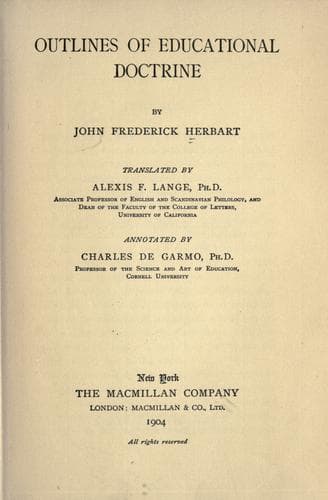
Outlines of Educational DoctrineHerbart, Johann Friedrich
Philosophy
Outlines of Educational Doctrine
Herbart, Johann Friedrich
Education -- Philosophy
=Note.=--The difficulty encountered in this subject--undoubtedly
one of those difficulties most keenly felt in teaching
mathematics--is after all only an illustration of the injurious
consequences of former sins of omission. If the geometrical
imagination were not neglected, there would be ample opportunity,
not only for impressing far more deeply the concept of proportion,
demanded even by elementary arithmetic, but also for developing
early the idea of function. The object lessons mentioned above
have already illustrated the dependence of tangents and secants
on angles. When these relations of dependence have become as
familiar as may be expected after a half year’s instruction, sines
and cosines also are taken up. But it is not sufficient to leave
the matter here. Somewhat later, about the time when mensuration
is introduced, the squares and cubes of natural numbers must be
emphasized, and very soon committed to memory. Next it should be
pointed out how by finding the differences of squares and cubes
respectively, and then adding these differences, the original
numbers may be obtained again. A similar treatment should be
accorded to figurate numbers.
Small wooden disks, like checker-pawns, commend themselves for the
purpose. By means of them various figures are found. The pupils
are asked to indicate how many disks they need to construct one
or the other kind of figures. A further step will be to show the
increase of squares and cubes corresponding to the increase of the
root, and to make this information serve as the preparation for
the elementary parts of differential calculus. Now the time has
come for passing on to the consideration of consecutive values of
the roots, which are found to differ by quantities of continuously
decreasing smallness as one progresses continuously through the
number system. And so, after the logarithms of 1, 10, 100, 1000,
etc., also of 1/10, 1/100, etc., have been gone over many times,
forward and backward, the conception is finally reached of the
interpolation of logarithms.
Public-domain text, read in full here on John Shaqi.
Reviews
Reviews
No reviews yet
Be the first to share your thoughts on this work.
Elsewhere in the archive
Join the Discussion
Join the discussion
Sign in to leave a comment or review.
Sign InorCreate an account