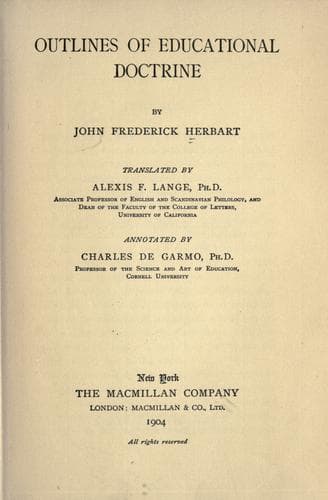
Outlines of Educational DoctrineHerbart, Johann Friedrich
Philosophy
Outlines of Educational Doctrine
Herbart, Johann Friedrich
Education -- Philosophy
The conclusion arising from this argument is that nature study
as an end in itself, or a thing apart from the real or imagined
experiences of the pupil, is but a faint reflection of what it may
become under a more rational treatment. In order of time, nature
study in the earliest grades may indeed rest upon the mere delight
of the childish mind in the new, the strange, the beautiful, and
especially in the motion of live creatures, and may be reinforced
by childish literature. When boyhood and girlhood begin, however,
then the industrial motive, first in the home environment, then of
primitive times, becomes the chief reliance for an abiding interest.
In the reproduction of primitive processes, there is of necessity
a historical element. When nature has attained a firm apperceptive
basis through imitation of primitive industrial processes, and has
obtained a historical background, then it may properly be further
reinforced by literary reference. The poetic value of nature will now
appeal to the mind with a potency that springs from inner life and
experience; scientific law will now have some chance of appealing to
the mind with something of the same reverence that Kant besought for
the moral law. The true order of appeal in nature study is therefore
as follows: For infancy, natural curiosity and delight in the
movements of living creatures; for the age of boyhood and girlhood,
imitation, real or imaginary, of processes depending upon natural
objects and forces, together with historical and literary reference;
secondarily, nature work may also appeal to youthful interest in
natural law or beauty.
[34] Dewey, John, “The Aim of History in Elementary Education,”
_Elementary School Record_, November, 1900, University of Chicago
Press.
259. With the foregoing should be conjoined much attention to external
nature, to the changes corresponding to the seasons, and to means of
intercommunication.
Under this head belongs, on the one hand, observation of the heavenly
bodies,--where sun and moon rise, how the latter waxes and wanes, where
the north star is found, and what arcs are described by the brighter
stars and the most conspicuous constellations.
Public-domain text, read in full here on John Shaqi.
Reviews
Reviews
No reviews yet
Be the first to share your thoughts on this work.
Elsewhere in the archive
Join the Discussion
Join the discussion
Sign in to leave a comment or review.
Sign InorCreate an account