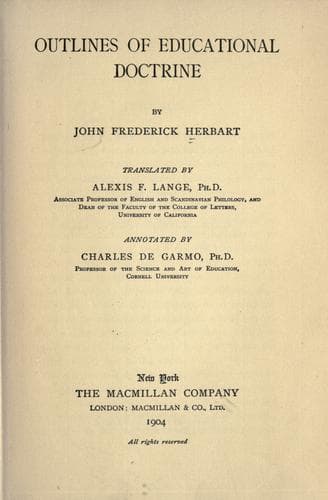
Outlines of Educational DoctrineHerbart, Johann Friedrich
Philosophy
Outlines of Educational Doctrine
Herbart, Johann Friedrich
Education -- Philosophy
Here belongs, on the other hand, technological knowledge, acquired
partly through direct observation, partly through lessons in
descriptive physical science. Technology ought not to be considered
merely from the side of the so-called material interests. It furnishes
very important connecting links between the apprehension of the facts
of nature and human purposes. Every growing boy and youth should learn
to handle the ordinary tools of the carpenter as well as rule and
compasses. Mechanical skill would often prove far more useful than
gymnastic exercises. The former benefits the mind, the latter benefit
the body. With burgher schools should go manual training-schools,
which does not mean that the latter must necessarily be trade schools.
Finally, every human being ought to learn how to use his hands. The
hand has a place of honor beside language in elevating mankind above
the brute.
The foregoing store of information also enters into the study of
geography; how, will appear in the next chapter.
The soundness of the foregoing remarks is witnessed by the rapid
development of manual training-schools in the last decade, and the
almost universal desire, if not practice, of providing considerable
amounts of manual training for the pupils of the grammar grades.
The girls usually have some form of sewing and cooking, while the
boys have sloyd or other similar tool work in wood. The _rationale_
of requiring girls to do carpenter work instead of the forms of
manual exercise that especially pertain to their sex is not yet
satisfactorily established.
260. On the observation of the heavenly bodies is based popular
astronomy, which provides a test as to whether the mathematical
imagination has been properly cultivated.
261. Elementary statics and mechanics will serve as an early
introduction to physics, which combines with the easiest portions
of chemistry. Long before physics is formally presented, it must be
foreshadowed by many things stimulating the attention. Notice is
directed to clocks, mills, the most familiar phenomena of atmospheric
pressure, to electrical and magnetic toys, etc. In burgher schools,
at least, so much must be said about buildings and machines as is
necessary to incite to further study in the future. The same holds for
the fundamental facts of physiology.
262. As often as a new topic for study is introduced, it is important
to give prominence to some of the salient facts, and these must be
accurately memorized. Moreover, pupils need to have practice in exact
description. Where practicable, these descriptions are corrected by
actually looking at the objects themselves.
Public-domain text, read in full here on John Shaqi.
Reviews
Reviews
No reviews yet
Be the first to share your thoughts on this work.
Elsewhere in the archive
Join the Discussion
Join the discussion
Sign in to leave a comment or review.
Sign InorCreate an account