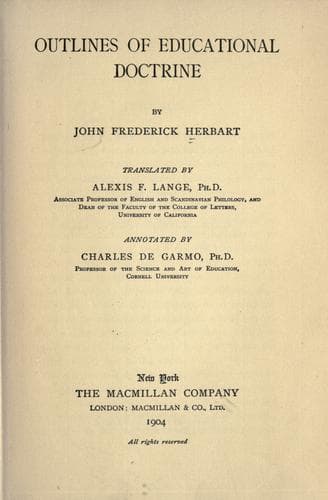
Outlines of Educational DoctrineHerbart, Johann Friedrich
Philosophy
Outlines of Educational Doctrine
Herbart, Johann Friedrich
Education -- Philosophy
Hasty and superficial observation of objects presented for inspection
always calls for severe criticism; else collections and experiments
become valueless. Nor should objects be shown too lavishly; pupils must
often be told beforehand what they will have to look for. Frequently
it may serve the purpose to employ successively good descriptions,
pictures, and direct observation.
CHAPTER IV
=Geography=
263. As to geography, at least two courses may be distinguished. One of
these is analytic and begins with the pupil’s immediate neighborhood,
the topography of the place, while the other starts with the globe.
Here only the former will be discussed, as the latter can be had
directly from good text-books.
=Note.=--The usual method of taking the globe as the point of
departure would be less open to criticism, if, in order to render
the conception of the earth’s sphericity more intelligible,
attention were directed to the shape of the moon, the observation
being carried on occasionally with the aid of a telescope. But
even if this is done, it still remains a blunder to substitute the
faint and vague idea of a huge ball for direct perception. Equally
injudicious is the plan of beginning with Portugal and Spain.
That spot where pupils and teacher are at the moment is the point
from which the pupils must take their bearings, and in thought
extend their horizon. It will never do to pass over the natural
starting-points provided by sense-perception.
Had the note to this section been properly heeded, we should not have
had to wait for fifty years after Herbart’s death before witnessing
the present rational methods of applying geographical science to
elementary education. It is the proud boast of the modern elementary
geography that it begins with a study of the pupil’s actual
environment. The term _home geography_ has now become a familiar one.
It signifies that the pupil is taught to observe the geographical
elements as they exist in his own neighborhood. He studies hills,
watercourses, soil, woods, lakes, together with the industrial
phenomena that come within the reach of his investigation. Upon
this primary sense-basis he rears the structure of his geographical
knowledge.
Public-domain text, read in full here on John Shaqi.
Reviews
Reviews
No reviews yet
Be the first to share your thoughts on this work.
Elsewhere in the archive
Join the Discussion
Join the discussion
Sign in to leave a comment or review.
Sign InorCreate an account