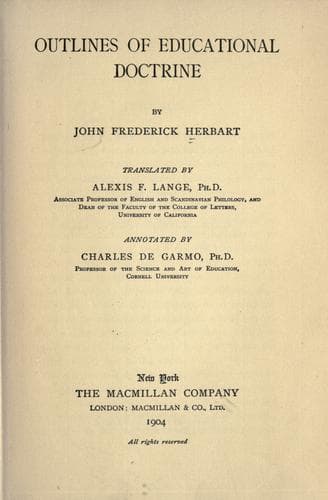
Outlines of Educational DoctrineHerbart, Johann Friedrich
Philosophy
Outlines of Educational Doctrine
Herbart, Johann Friedrich
Education -- Philosophy
264. Geography is an associating science, and use must be made of
the opportunities it offers for binding together a variety of facts,
none of which should be allowed to remain isolated in the mind of the
learner. It is not the mathematical portion, supplemented and made
interesting by popular astronomy, that serves as the first connecting
link between mathematics and history (second course); even the
rudiments of geography may, on the basis of observation exercises,
furnish practice in the determination of triangles which occur on the
first maps used, although this step is not always necessary when once
some skill has been acquired in singling out features worthy of note.
(The determination of position by latitude and longitude is, for the
first course, as irrational as the action of a traveller in Germany
or France would be if he set about to put together the picture of the
places where he expects to remain, with the aid of their relation to
the equator and the first meridian.)
Physical geography presupposes some knowledge of nature, and furnishes
the occasion for enriching that knowledge. Political geography
designates the manner in which man inhabits and uses the earth’s
surface. It is the pedagogical aim of instruction in geography to
associate all this.
265. The teacher must cultivate the art of narration; his accounts must
resemble those of a traveller. But the narrative should conflict with
the determination of the relative position of places (by grouping them
about one principal place, and in the case of more than one by the use
of triangles) as little as, in teaching history, the story of events
should conflict with the scheme of chronology. The two go together. The
narrative is to present a clear picture, and to this end requires the
support of a few fixed points in space. On the other hand, these points
should not remain isolated; they are to be connected by the lines of
the picture.
266. It is not a matter of indifference how many unfamiliar names are
mentioned in one minute or hour. Nor is it immaterial whether they
are uttered before or after perception of the picture which the map
presents. The first requisite is that every map placed before the
pupils be conceived of as a country; three, at most four, names of
rivers, and the names of a few mountains are sufficient; completeness
is out of place here. The few names given provide ample opportunity
for fixing the position of notable points, both with reference to one
another and to the boundary lines of the country.
Public-domain text, read in full here on John Shaqi.
Reviews
Reviews
No reviews yet
Be the first to share your thoughts on this work.
Elsewhere in the archive
Join the Discussion
Join the discussion
Sign in to leave a comment or review.
Sign InorCreate an account