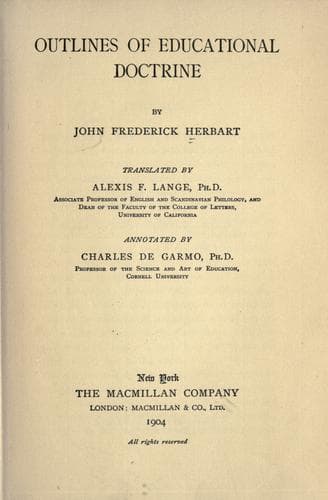
Outlines of Educational DoctrineHerbart, Johann Friedrich
Philosophy
Outlines of Educational Doctrine
Herbart, Johann Friedrich
Education -- Philosophy
Due prominence having been given to these geographical features, they
should then be connected, say with the aid of a blackboard, on which
they are roughly sketched one by one, and properly joined together
afterward. In the case of the sources and outlets of rivers, this may
be done by a line to indicate the course. If now the pupils have made
good previous use of their eyes, especially if they have noticed the
fall of brooks and rivers, and have observed the slope of the ground
in a particular region,--if they have not, the deficiency must be made
good first of all,--it will not be too early to pass on to a general
description of the appearance which the country under consideration
would present to a traveller. And now the time has come for a somewhat
fuller mention of the names of rivers and mountains, but these names
must at once be gone over several times by the pupils. Doing so will
reveal whether the list of new names has been made too long; it is
often largely due to carelessness in this respect, if the study of
geography proves barren or onerous. Next in order follow detailed
descriptions of particular wonders of nature, where there are such.
Attention is then given to some of the principal cities, mention
being made of the number of inhabitants. Here the determination of
relative location comes in again, and for this the self-activity of the
pupils is indispensable. Finally, human industry and art, so far as
they relate to the products of the country, together with the little
of political organization that pupils can grasp. The names of the
provinces should ordinarily be omitted from the first course.
Public-domain text, read in full here on John Shaqi.
Reviews
Reviews
No reviews yet
Be the first to share your thoughts on this work.
Elsewhere in the archive
Join the Discussion
Join the discussion
Sign in to leave a comment or review.
Sign InorCreate an account