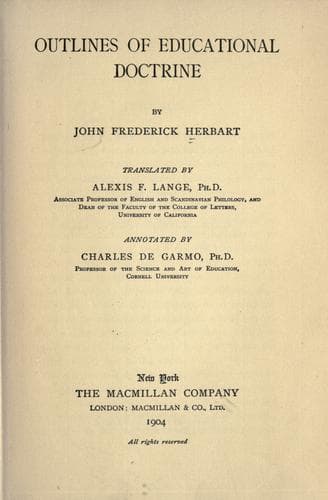
Outlines of Educational DoctrineHerbart, Johann Friedrich
Philosophy
Outlines of Educational Doctrine
Herbart, Johann Friedrich
Education -- Philosophy
This section is suggestive of the old geography of the last half
century,--location, names, maps, the barren details of the science.
Geography is something richer than all this. The old geography was
political in the foregoing sense. The first break was in making it
physiographical, the last in making it social. Names as such are
nothing, and physical facts little more, but both become of value
as soon as they are brought into relation to man,--his life, his
work, his recreation. Geography is not essentially the location of
places, nor is it physiography, but it is a study of the essential
facts concerning the surface of the earth as they are related to man
himself; it is, in short, _human_ in the fullest sense. It gives a
concrete explanation of civilization; it explains the production,
the exchange, and, to some extent, the consumption of goods. It
contrasts countries, not so much by square miles, as by the number
of miles of railroads they possess. (The most momentous fact of
modern civilization is the railroad. Twelve billions of dollars are
invested in it in the United States alone. In view of these facts,
what shall be said of those recent geographies that keep the children
poring over primitive maps for years--maps without a suggestion of a
railroad in them? This is an illustration of how prone education is
to lag behind the progress of society.)
267. The reviews, which should be frequent, must steadily work toward
a growing firmness of association between names and places. Each name
is to be referred to the place it designates; hence the sequence of
names must often be reversed, and the map looked over in all directions
and from all points of view. How far to go is determined in accordance
with individual capacity. From some, only what is absolutely essential
can be demanded; from others, much more, in order that they may exert
themselves properly.
268. In the midst of other studies on which greater stress is laid,
geography is as a rule slighted by pupils and sometimes even by
teachers. This attitude merits severe criticism. Instruction in
geography may be reduced to a minimum, the first course even requires
this, but it should not be disparaged. With many pupils, geography
is the first study which gives them the consciousness that they can
learn as they are expected to learn. With all pupils, geography must
connect the remaining studies and must keep them connected. Without
it everything remains unstable. Historical events lack places and
distances; products of nature are without the regions where they are
found; popular astronomy, which is called upon so often to prevent
and dispel erroneous notions, is deprived of its very basis, and the
geometrical imagination of one of its most important incentives. If the
facts of knowledge are allowed to fall asunder in this way, instruction
endangers the whole of education.
CHAPTER V
=The Mother-tongue=
Public-domain text, read in full here on John Shaqi.
Reviews
Reviews
No reviews yet
Be the first to share your thoughts on this work.
Elsewhere in the archive
Join the Discussion
Join the discussion
Sign in to leave a comment or review.
Sign InorCreate an account