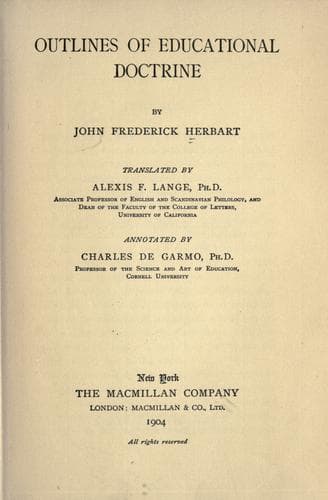
Outlines of Educational DoctrineHerbart, Johann Friedrich
Philosophy
Outlines of Educational Doctrine
Herbart, Johann Friedrich
Education -- Philosophy
269. There would be less controversy about language teaching if
existing differences in conditions were given proper attention.
The most general distinction to make is that between understanding and
speaking. The distance between the two is a given factor at the time
when regular instruction begins. It is very great in some cases, and,
again, slight in others, according to individual aptitude and early
surroundings.
270. First of all, one’s language was acquired by hearing it spoken, by
receiving it from others, by imitation; it was refined or vulgar; it
was perceived accurately or indistinctly; it was imitated by organs,
good, bad, or indifferent. Little by little the imperfections of the
earliest stage are outgrown, where cultured persons set a daily example
and insist on correctness of speech. Sometimes, however, it takes years
to bring about such a result.
271. Another factor, and one deeply rooted in individual temperament,
is the stronger or weaker impulse toward expression through language.
This fact elevates the language of each one above mere imitation; its
improvement must start from the thoughts which it seeks to express.
Striking progress of this kind often occurs during adolescence.
The differences noted in this and the two preceding sections are
psychological, hence common to German and American children. The
problem of teaching American children their mother-tongue, assumed to
be English, is both harder and easier than to teach German to German
children. It is easier in that English is mostly uninflected, hence
unencumbered by nice distinctions in grammatical form. This same
fact, on the other hand, causes didactic difficulties, since most
teachers are at a loss as to what definite body of knowledge they
should or can impart that will train the child into a mastery of good
English speech. The last twenty years have seen a large number of
experiments on the part of authors in the effort to present a body of
information and exercises calculated to secure a good training in the
mother-tongue. These efforts have met with but partial success, owing
to the inherent difficulties of the subject. Many who can teach a
foreign language, where there is a movable fulcrum of difficulties to
be overcome, such as those found in inflection, or in the meaning of
foreign words, fail when confronted by a language that is practically
uninflected, and in which the words are easily understood.
The old recourse was technical grammar. But this is an analytical
study, calculated to lead to apprehension of subtle meanings, rather
than to an instinct for correct form. Furthermore, the grammar cannot
be successfully studied until after the habits of speech are fairly
fixed. For these reasons, it bears much the same relation to living
speech that formal logic does to real thinking. Grammar makes the
mind keen to detect formal errors of speech, just as logic trains
one to detect fallacies in reasoning.
Public-domain text, read in full here on John Shaqi.
Reviews
Reviews
No reviews yet
Be the first to share your thoughts on this work.
Elsewhere in the archive
Join the Discussion
Join the discussion
Sign in to leave a comment or review.
Sign InorCreate an account