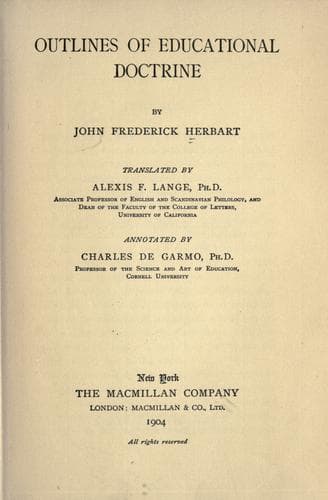
Outlines of Educational DoctrineHerbart, Johann Friedrich
Philosophy
Outlines of Educational Doctrine
Herbart, Johann Friedrich
Education -- Philosophy
The first important instrument for securing good English in the
early primary grades is narration by the teacher and repetition
by the children. This means, potent enough to form the speech of
any child whether from the slums or from the homes of those who
know no English, is rarely utilized up to the full measure of its
efficiency. Teachers are filled with the prepossession that they
must enable their pupils to write good English, forgetting that if
the mind is habituated to _think_ in good English first, the problem
of writing it is well-nigh solved. The requisites for successful
oral training in the mother-tongue are first, the selection of a
body of interesting and appropriate literature, and second, skill in
narration by the teacher. Given these two things, and we have the
first in great abundance, and every child will be able in a year
to give extended and correct speech within the range of his sphere
of thought to an almost unlimited extent. His tenacious memory for
forms frequently heard, together with his delight in repeating almost
word for word stories told in his presence, will produce astonishing
facility in correct speech. As much of this may be written as seems
best, but it is probable that there would not be great loss if a
child were not called upon to write a ‘composition’ before he is ten
or twelve years old. Could we be sure he would go through the high
school, formal writing might be postponed until he enters it. Not
much is ever gained by attempts to produce fruit before its natural
period for appearing.
Upon the basis of this training in correct oral speech, the children
may begin, when nine or ten years of age, to have systematic language
lessons, which should be calculated to produce two results: first, a
facile use of the pen in recording thought, special caution being
given not to weary the mind and body too much by unduly extending
the length of the written exercises; second, an inductive approach,
through brief written exercises, toward the classifications and
distinctions of technical grammar. To be of use, this latter
requirement should be clearly understood. The method of approach
is purely synthetic. It consists in devices to enable the pupil
repeatedly to use a given construction, say a relative pronoun, until
the name and construction seem natural from use alone.[35]
At the age of thirteen or fourteen the analytical study of grammar
should be begun. The essential thing here is that the pupil should
connect _words_ with the _ideas_ they express, and _sentences_ with
the _thoughts_ that give rise to them.[36] Seeing mental distinctions
clearly, he has small difficulty in their written or oral expression.
[35] For extended illustration of this point, see the “Annotator’s
Language Lessons,” the Werner School Book Co., New York, Boston, and
Chicago.
Public-domain text, read in full here on John Shaqi.
Reviews
Reviews
No reviews yet
Be the first to share your thoughts on this work.
Elsewhere in the archive
Join the Discussion
Join the discussion
Sign in to leave a comment or review.
Sign InorCreate an account