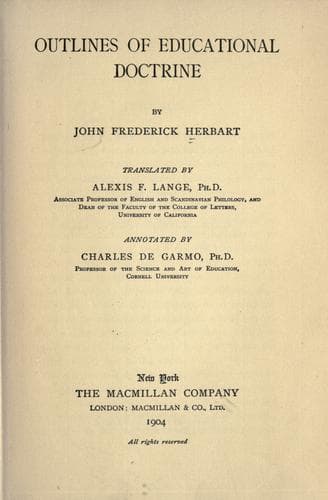
Outlines of Educational DoctrineHerbart, Johann Friedrich
Philosophy
Outlines of Educational Doctrine
Herbart, Johann Friedrich
Education -- Philosophy
[36] This position is best exemplified by Mr. George P. Brown in his
“Essentials of English Grammar,” the Werner School Book Co., New York,
Boston, and Chicago.
272. Now such facts might seem to point to the conclusion that no
special periods of instruction are needed for the mother-tongue, or
at least not for language lessons alone. On the one hand, it might be
urged that cultured teachers will improve the language of their pupils
by their mere example, and by the occasional corrections which will of
course be necessary; while, on the other hand, the gradual progress of
mental development will shape the means of expression from within, to
the natural limits of individual capacity. But before accepting the
view here given, we need to remind ourselves, in the first place, that
for a long time the educated teacher is only imperfectly understood by
the uneducated listener, and that instruction is very much impeded if
each unusual turn of expression necessitates an inquiry as to whether
its meaning is clear.
273. But this is not all. Language is also to be read and written.
Hence, it becomes a standing object for consideration, and, to one
whose knowledge of it is deficient, a source of embarrassment.
Accordingly, the first thing for the teacher to do is to show
analytically, on the basis of what has been read or written, how
the meaning would be lost or altered if either single words were
interchanged, or the inflectional endings (especially in German) were
incorrectly chosen. That the synthesis of sentences should follow next,
advancing step by step toward greater complexity, especially by means
of various conjunctions, may be assumed to be well understood.
274. Now if all experienced equal difficulty in their reading and
writing, the language lessons designed as a remedy would commend
themselves in all cases, and might fittingly be carried to the same
extent everywhere.
But here the widest divergence appears. Accordingly, where many are
being taught together, the teacher will seek to connect language work
with other subjects. Thus, in the course of the same recitation,
analytic instruction may be directed to the language side for some
pupils, while for others it may be given a far wider scope. Moreover,
the accompanying written exercises may have a corresponding diversity.
275. The work of a recitation period will be further diversified by the
introduction of exercises in reading aloud, and in oral reproduction.
But never will it be possible to raise all pupils to the same plane of
proficiency. Here, above all, the determining power of individuality
must be acknowledged.
Public-domain text, read in full here on John Shaqi.
Reviews
Reviews
No reviews yet
Be the first to share your thoughts on this work.
Elsewhere in the archive
Join the Discussion
Join the discussion
Sign in to leave a comment or review.
Sign InorCreate an account