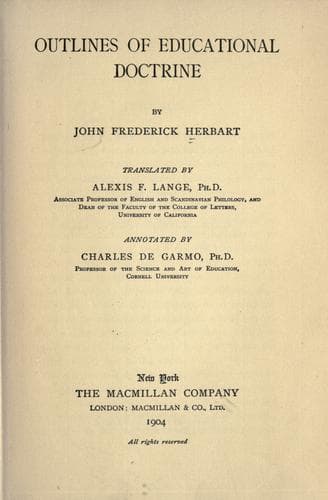
Outlines of Educational DoctrineHerbart, Johann Friedrich
Philosophy
Outlines of Educational Doctrine
Herbart, Johann Friedrich
Education -- Philosophy
276. For older boys and young men, the work in the mother-tongue will
consist partly in the study of excellent examples of the various kinds
of poetry and oratory, partly in the writing of essays. Such study
will prove the more profitable, the more perfect the models, the more
suitably they are adapted to the stage of culture already attained
by the student, and the more scrupulously the teacher refrains from
forcing upon him a literary taste not congenial to his nature. The
least promising of all written exercises are those in letter-writing.
Confidential letters every one can write, each in his own way. Best of
all are written exercises with a definite and rich store of thought
to draw from and admitting of various forms of treatment. Several may
then emulate each other in handling the same theme, and the process of
correcting will awaken greater interest in consequence.
CHAPTER VI
=Greek and Latin=
277. As is well known, the exposition of grammatical distinctions
and of the many turns of expression whereby language may become an
adequate symbolization of thought, gains very materially in clearness
by a comparison of the mother-tongue with Latin and Greek. Even with
boys not more than eight years old the attempt may be made to utilize
this advantage in the teaching of English, whether it has been finally
decided, or not, that they are to take the regular classical course.
Some boys learn, without much trouble, enough of Latin inflections to
enable them soon to translate short sentences from the mother-tongue
into Latin, and _vice versa_.
The present plan in Germany is to have boys in the gymnasia begin the
study of Latin at the age of ten. The study is continued for a period
of nine years. Greek is begun three years later and continued for
six years. In the United States the prevailing plan is to postpone
the study of Latin until the pupil enters the high school at the age
of fourteen or fifteen. Good private schools and many city grammar
schools permit children to begin when some two years younger than
this. The Report on College Entrance Requirements made before the
National Educational Association in 1899 suggested the propriety
of extending the influence of the high school over the two highest
grades of the grammar school, making in effect a six-year high school
course. For students who expect to enter college or technical schools
this plan offers great advantages, since it permits the desirable
preparation to be distributed over six years instead of being
concentrated into four.
Public-domain text, read in full here on John Shaqi.
Reviews
Reviews
No reviews yet
Be the first to share your thoughts on this work.
Elsewhere in the archive
Join the Discussion
Join the discussion
Sign in to leave a comment or review.
Sign InorCreate an account