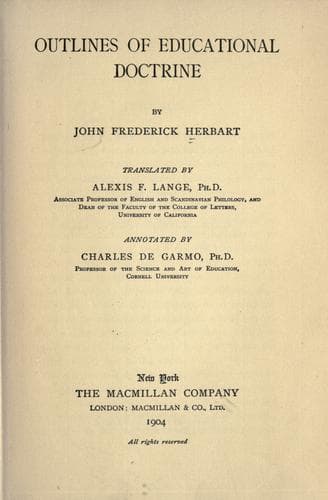
Outlines of Educational DoctrineHerbart, Johann Friedrich
Philosophy
Outlines of Educational Doctrine
Herbart, Johann Friedrich
Education -- Philosophy
278. This experiment will not, however, be long continued; since, with
the large majority of pupils, the difficulties accumulate so rapidly as
to lead unavoidably to the admission that the burden cannot be assumed
merely for the sake of incidental advantages. Moreover, the customary
view, handed down from the time of the Reformation, of the relation of
the classical languages to the sciences, and to the needs of the age,
is undergoing a change more and more apparent from decade to decade.
The labor implied in the study of the ancient languages now pays only
where talent combines with the earnest purpose to achieve the most
complete scholarship.
This remark is prophetic of the enormous increase of instruction
in the sciences since Herbart’s day, yet Latin has also enjoyed a
phenomenal increase in popularity in American schools. According to
the Report of the National Commissioner of Education the increase of
enrollment in high schools for the years between 1890 and 1898 was
84 per cent, while the increase in the number of students pursuing
Latin was 174 per cent.[37] This surprising growth in the number
pursuing an ancient language can hardly be accounted for by increased
stringency in college entrance requirements in Latin, but must rather
be ascribed to a growing conviction among the people that the study
is indispensable in secondary education. That this must be the case
is seen by the attendant circumstances. In the first place, Latin has
become an elective in nearly all high schools; in the next place,
many rich equivalents are offered, both in science and in modern
languages; and finally our system of universal elementary education
has sent large classes of persons into the secondary schools that
have never previously been there. Yet the number of students electing
this study grows by leaps and bounds.
=Note.=--(1) The assertion is often heard that the ancient
languages supply a permanent standard by which to judge of the
progress and the decay of modern languages; also that the ancient
classics must be regarded as furnishing the models for purity and
beauty in style. These and similar contentions are undeniably
correct, and carry the greatest weight, but they are unpedagogical.
They embody the absolute requirement, but not that which younger
pupils need for _their_ culture; and the large majority of those
who are fitting themselves for official positions cannot afford to
make themselves guardians of language and style. They must take
language as it is, and acquire the manner of expression which is
adapted to the world of affairs. Those higher cares belong to
authors, but no one is educated for authorship.
Public-domain text, read in full here on John Shaqi.
Reviews
Reviews
No reviews yet
Be the first to share your thoughts on this work.
Elsewhere in the archive
Join the Discussion
Join the discussion
Sign in to leave a comment or review.
Sign InorCreate an account