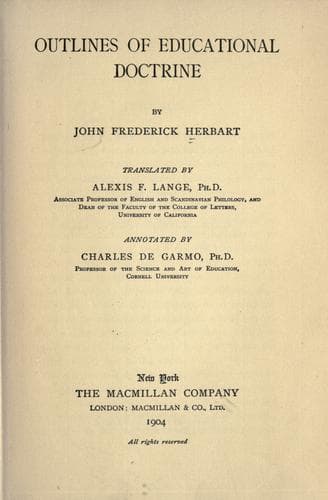
Outlines of Educational DoctrineHerbart, Johann Friedrich
Philosophy
Outlines of Educational Doctrine
Herbart, Johann Friedrich
Education -- Philosophy
(2) It is a familiar notion that the difficulty would diminish if
the ancient languages were begun later, that then the ability to
learn would prove greater. On the contrary, the older the pupil the
stronger the tendency of his thought-mass toward exclusion. Memory
work must be introduced early, especially where its usefulness
depends wholly on the acquisition of facility. It is essential to
begin early in order to make it possible to proceed slowly and to
avoid unpedagogical pressure. Four hours a week of Latin do not
hurt a healthy, bright boy, provided his other tasks are arranged
with pedagogical correctness. To put modern languages first would
be to put the cart before the horse. Useful enough, however, are
single French and English expressions relating to everyday life.
They will be of service in acquiring the pronunciation; but a few
phrases do not constitute the teaching of a language.
[37] Bennett and Bristol, “The Teaching of Latin and Greek,” Longmans,
Green & Co., New York, 1900.
279. The manner of teaching the ancient languages, where they are
regarded as a matter of necessity or conventionality, no account being
taken of pedagogical considerations, need not be discussed here. It
must rather be admitted at once that no pedagogical means whatever
exist, whereby those who live with their interests strictly confined
to the present could be brought to acquire, with genuine sympathy, the
content of the works of antiquity.
American teachers in estimating the value of Latin for the high
school student lay more stress upon training in the mastery of the
mother-tongue than upon the literary contents of the classical
writings. Professor Bennett in his treatment of “The Teaching of
Latin in the Secondary School,”[38] places in strong light the
splendid linguistic training a youth undergoes when taught by a good
teacher of this subject. In Germany, since Herbart’s time, Professor
Russell tells us that the teaching of Latin has fluctuated between
two aims--“between that view which makes the classics a purely formal
discipline, and that other view which bases the worth of such a
study on the acquisition of humanistic culture, in contact with ‘the
best thoughts of the best men of antiquity.’ In the one case it is
considered of equal value as a means of preparation for all trades
and professions dependent on intellectual acumen; in the other case
it is of worth only for those who can practically apply the technical
knowledge thereby acquired, or may have sufficient leisure to enjoy
its æsthetic qualities. It is a question of making the ancient
literature a means to an end or an end in itself.”[39]
The dogma of formal discipline as a leading aim in education has
nowhere been more discredited than among Herbartian writers. A
judicious estimate of its truth and error is made by Professor
Hinsdale.[40] His main conclusions are as follows:--
Public-domain text, read in full here on John Shaqi.
Reviews
Reviews
No reviews yet
Be the first to share your thoughts on this work.
Elsewhere in the archive
Join the Discussion
Join the discussion
Sign in to leave a comment or review.
Sign InorCreate an account