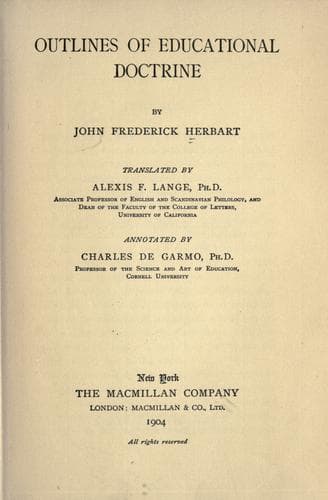
Outlines of Educational DoctrineHerbart, Johann Friedrich
Philosophy
Outlines of Educational Doctrine
Herbart, Johann Friedrich
Education -- Philosophy
1. The degree to which power generated by education is general
depends upon the extent to which it energizes the mind, and
particularly the extent to which it overflows into congruent channels.
2. Such power is far more special than general; it is only in a
limited sense that we can be said to have a store of mobilized mental
power.
3. No one kind of mental exercise--no few kinds--can develop the
whole mind.
4. No study, no single group of studies, contains within itself the
possibilities of a whole education.
On the other hand, American students rarely study classics long
enough to acquire much facility in mastering the literary contents of
the ancient writers. If, to considerable extent, the idea of formal
discipline is a delusive one, and the idea of a broad, humanistic
culture is an illusion of the American schoolmaster, we must justify
the study of Latin upon other grounds. The linguistic advantages
arising from it are obvious and decided. Among these stands first the
mastery of the mother-tongue, first through the comparative study
rendered necessary by translation, then by study of the roots of a
large part of the English vocabulary, and more remotely by the light
thrown by Latin upon history and institutional life.
There is an advantage in Latin of great, though usually unmentioned,
importance, and that is its peculiar usefulness as an educational
instrument, in that it presents to the pupil a graduated scale of
surmountable difficulties. In this respect it is surpassed only by
mathematics. The difference between a good and a poor educational
instrument lies in this: a study offering few surmountable obstacles
is a poor educational instrument, for the pupil can find no fulcrum
upon which to use his mental powers. Thus he may stare at a natural
object when directed to observe its characteristics, but he finds
it hard to think when no thought problem is presented to him. But a
study that involves thought problems of a definite and solvable kind
is a good educational instrument, for the pupil finds something to
move and a fulcrum upon which he may exert his power. Translation
from an ancient language exercises the working powers of a student up
to their highest efficiency, for the translation of ten sentences may
easily provide the hardest kind of work for an hour; if ten lines do
not, then more lines will. When a foreign language ceases to offer
such surmountable difficulties, we leave it for something else that
does offer them.
[38] Bennett and Bristol, “The Teaching of Latin and Greek,” pp. 11–32,
Longmans, Green & Co., New York, 1900.
[39] Russell, “German Higher Schools,” Longmans, Green & Co., New York,
1899.
[40] Hinsdale, “Studies in Education,” pp. 46–61, Werner School Book
Co., Chicago, 1896.
Public-domain text, read in full here on John Shaqi.
Reviews
Reviews
No reviews yet
Be the first to share your thoughts on this work.
Elsewhere in the archive
Join the Discussion
Join the discussion
Sign in to leave a comment or review.
Sign InorCreate an account